Paralympic Medal Count

2

1

3

   Olympic Medal Count

10

13

7

Paralympic Medal Count

2

1

3

The Games are About to Begin

The Games are About to Begin

Writing these words in late January, 2024, it is as difficult to believe that the Tokyo Olympic Games of 2021 were two and a half years ago as it is that the Games of the XXXIII Olympiad will begin in Paris in just about five months’ time (July 26th). Time, it may be said, passes with the speed of an Olympic sprinter.

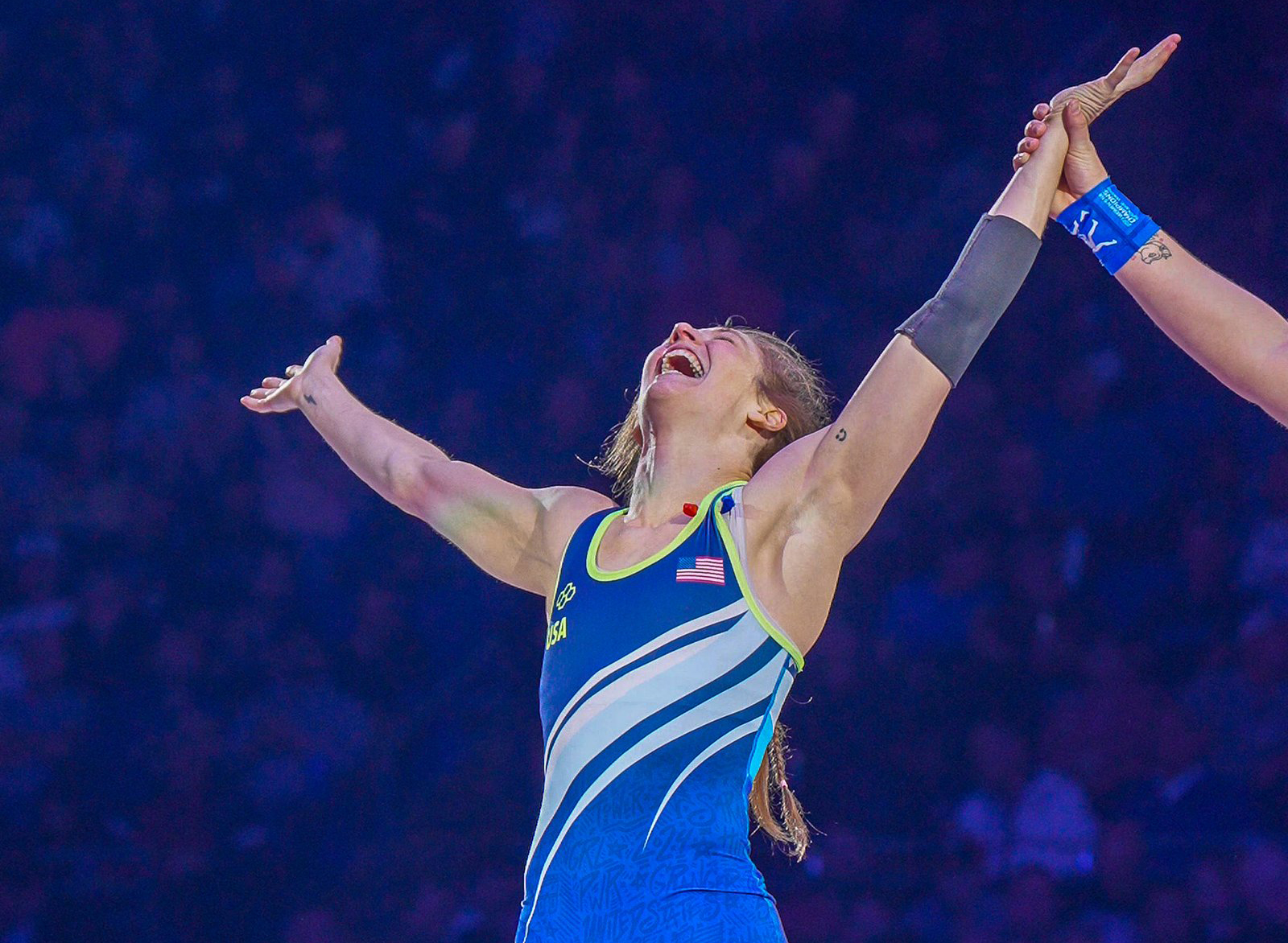
At the New York Athletic Club, it is understandable that our focus should be resolutely focused on the Olympic Games at this moment in time. With the new year beginning, the months ahead are filled with anticipation of what may unfold. There is, after all, precedent. To this moment in time, NYAC athletes have won 291 Olympic medals and five Paralympic medals; 166 of those have been gold (164 Olympic, two Paralympic). Fifty-five NYAC athletes competed in Tokyo, securing 20 medals, 10 of which were gold. By those measures, we may be excused for feeling optimistic that similar numbers will have been tallied once the Paris Games conclude.

At the time of this writing, four NYAC athletes have already secured their places on the US team for Paris. Morgan Pearson and Taylor Knibb claimed slots on the triathlon team by virtue of their placings in the Paris Test Event last summer; Jess Davis earned her ticket to France by virtue of her placing in the Pan Am Games modern pentathlon competition in Santiago, Chile in the autumn; and Tatyana McFadden secured her position on the Paralympic Games marathon starting line thanks to her placing in last November’s New York City Marathon. We may rest assured that all four are deep into preparation for the coming Games and that, all being well, they will be joined by a glut of their club-mates in the coming months.

You can find bios of our current four Paris Olympians, by going to the Team NYAC page; and as team selections are made in the coming months, the news will be documented here, as will all manner of Olympics-related updates. Once the Games themselves begin, this will be your one-stop site for all you need to know about the NYAC in Paris.

What, then, may we expect? From a competitive perspective, we could not be faulted for expecting to claim medals in water polo, track and field, triathlon and wrestling; but our judokas, rowers and fencers should not be overlooked, nor indeed should any NYAC athlete on the team. There is, as we know, no such thing as a sure thing and, once the curtain rises on these Olympic Games, all athletes are created equal and all medals are up for grabs.

As for the Games themselves, it is certain that Paris will produce a spectacle and that, being considerably more accessible than the sites of the last two Games (Rio de Janeiro and Tokyo), the City of Light will be inundated with fans from all over the world. Those who make the journey will be treated to the first ever Opening Ceremony to take place outside of a stadium; will witness 32 sports including four new ones – breaking, surfing (although, this is being held in Tahiti), skateboarding and surfing; and will be among 10,500 athletes, 31,500 volunteers, 20,000 journalists and several million visitors, all spread across 41 venues.

All of which is to say that, while the competitions may be unpredictable, these Games, the third to be held in Paris (the others being in 1900 and 1924), and the first open to the public in eight years, are certain to be among the most joyous and the most memorable ever. Que les jeux commencent!

James O’Brien

14 Olympians…and Counting

14 Olympians…and Counting

With each passing week, the Games of the XXXIII Olympiad are drawing inexorably closer. The Opening Ceremony will take place on Friday, July 26th, an occasion that will be observed in multifarious ways at the NYAC, not least by the 100 Days Out virtual event that will be taking place on April 17th with Jimmy Pedro (two-time judo bronze medalist), Meghan Musnicki (two-time rowing gold medalist), Joe Kovacs (two-time shot put silver medalist) and Omari Jones (Olympic debutant in Paris for boxing) as guest panelists.

The countdown to the Games also means that more NYAC athletes (fingers crossed) are being selected to compete in Paris. Some teams will not be finalized until five or six weeks prior to the Games; however, 14 Club members have already secured their places and are deep into preparations that they hope will see them produce performances of a lifetime once they reach the French capital. By name, those athletes are:

  • Jess Davis, modern pentathlon (these days, more often referred to as simply the “pentathlon”), who is frequently seen working out at the City House.
  • Omari Jones, boxing, the first NYAC pugilist of modern times – possibly ever –  to compete at an Olympic Games.
  • Tatyana McFadden, Paralympics marathon. A 20-time Paralympics medalist (19 summer, one winter) who, more than likely, will contest a handful of other events in Paris.
  • Taylor Knibb, triathlon, a silver medalist from the mixed team relay in Tokyo, now one of the world’s most formidable competitors at both Olympic and Ironman distances.
  • Morgan Pearson, triathlon, a silver medal-winning team-mate of Knibb’s from the mixed team relay in Tokyo, presently in the shape of his life.
  • Nick Mead, rowing, men’s four, a silver medalist from last year’s world championships and a member of the men’s eight that placed fourth in Tokyo.
  • Molly Reckford, rowing, lightweight women’s double sculls, a fifth place finisher in Tokyo and silver medalist in 2022 at the world championships.
  • Charlotte Buck, Olivia Coffey, Claire Collins, Meghan Musnicki, Kelsey Reelick, Regina Salmons and Maddie Wanamaker, rowing, women’s eight and four. Buck and Coffey both competed in Tokyo, while Musnicki competed in London, Rio and Tokyo and already has two gold medals.

Even a cursory reading of the above leaves one powerful impression: that the level of accomplishment among the NYAC’s athletic members is almost beyond compare. And bear in mind that these are still early days in the selection process. Many wrestlers will be named in the middle of April, with the selection impetus gaining speed as we head into spring. At the Tokyo Olympics and Paralympics, a total of 58 NYAC athletes took part. The early indicators are that our athletes may reach those numbers again this time around. In the interim, we can celebrate the fact that 14 members are in the process of writing the next chapter in the NYAC’s storied Olympic history.

James O'Brien

Keeping Up With Our Athletes

Keeping Up With Our Athletes

As I write these words, the New York Athletic Club is enjoying a unique problem. Namely, attempting to stay abreast of all of its athletes who are challenging for places on the Olympic team that will compete in Paris. With such a depth of athletic prowess on the Club’s roster, across multiple sports, this should be no surprise. There are few clubs in the world that have the athletic pedigree of the New York Athletic Club, a fact evidenced by the 291 Olympic and five Paralympic medals that its members have claimed to this point in time.

Keeping up to date with what all of those athletes are doing on a year-round basis can be challenging, though also enlightening and inspiring. That becomes all the more so in an Olympic year, when major tournaments and trials come thick and fast, as athletes gather momentum in their metaphorical – and sometimes literal – races towards the Games. Mid-April this year offered a prime example, with the NY Open Judo Tournament, one of the premier judo tournaments in the world, taking place at the City House on April 13th, followed four days later by the NYAC’s 100 Days Out virtual event, featuring Paris 2024 boxer Omari Jones. (To watch the full 100 Days Out event, click here). This was followed, two days later, by the US Olympic Wrestling Trials in State College, PA, at which Club members Sarah Hildebrandt and Adam Coon fought their way onto Team USA. Just days after that, USA Fencing announced its full Olympic roster, with Kat Holmes being added to a list that already included Anne Cebula and Mitchell Saron. To say that it was a whirlwind of activity is an understatement. And it is still going.

With the addition of Hildebrandt, Coon and Holmes to Team USA, at the time of writing the NYAC could boast of 19 members having been selected to compete at the Olympic and Paralympic Games. By any measure, that is an impressive number, and this with many sports still having to hold their trials. In addition, some sports that have already selected athletes have the latitude to select still more, among them wrestling, rowing and triathlon. It is significant to note that sports such as swimming, judo, track and field and water polo – sports in which the NYAC presently has powerhouse teams – have yet to name any members to the Olympic team. That being the case, we may feel optimistic that the NYAC representation in Paris will be as robust as it was in Tokyo, where the Club had 56 Olympians and two Paralympians.

If one looks back to the early days of NYAC Olympic participation, it can be salient to note that, in the Paris Games of 1900, NYAC members claimed 22 medals; and, in the Paris Games of 1924, Club members returned home with 14 medals. Both tallies are remarkable and may be the envy of many countries. The question becomes, therefore, “Can the NYAC emulate those numbers in Paris in 2024?” At the last Olympic Games, in Tokyo in 2021, the Club’s athletes earned a stunning 20 medals, plus three from the Paralympic Games. We may become blasé about those kinds of numbers; but it is important to remember that they are beyond the reach of many nations. That said – and, hopefully, this comes to pass – if keeping up with the Club’s athletes’ qualifying tournaments is a challenge, it will be all the more so once they have fought their way onto the team for Paris and the real competition, that for Olympic medals, begins.

Check back frequently in the coming days and weeks as we introduce you to many of those NYAC athletes who have already earned selection.

James O'Brien

Q&A with Olympic Fencer Mitchell Saron

Q&A with Olympic Fencer Mitchell Saron

As the Olympic Games approach and as NYAC athletes are selected to compete in Paris, we will be speaking with them to gain insight into their journey to the Games, into their preparations and into their aspirations once competition begins in the cauldron of Olympic competition. Here we speak with first-time Olympian, sabreur Mitchell Saron. 

Is the most challenging part of fencing mental or physical?
Both the mental and the physical are crucial in fencing. At elite levels in any sport, mental agility often gives competitors an edge. Of course physical fitness is essential, but I focus equally on mental training, using techniques like meditation, journaling and psychology, alongside rigorous physical preparation. I train at the NYAC multiple times per week when I’m not on the road.

What attribute do you possess that you feel sets you apart from other fencers?
My mentality and my training. I work extremely hard. I’m taking a very holistic approach in my daily routine. Daily training on the fencing strip, regular weightlifting and calculated nutrition, in combination with work on my mental strength. I definitely encourage my team members to do these things, but I like going to the extreme. I regularly meditate, do ice baths, use red light therapy, drink and eat raw dairy, eat only grass fed meat, cut out alcohol entirely, and my personal list goes on. To keep improving heading toward the Olympic Games, training must be full of improved repetition and strong, disciplined habits.

How did your pre-qualification training block compare to your current training preceding the Games?
A lot of my pre-qualification training mirrors my current training simply because the stakes feel the same, even though the weight on my shoulders is different. The pressure of qualifying felt like a do-or-die situation; it demanded total focus and intensity. Now, with my spot secured, the training still carries that high stakes atmosphere, but with added layers of mental preparation that I’ve built up over months. My goal is to elevate these efforts as I prepare with my teammates for the Olympics.

How are you mentally preparing for the Games?
Going to the Olympics has been a dream of mine since I was nine and got into fencing. Every morning, I set the tone for the day with a routine that includes journaling, meditation, and an ice bath—challenges that wake up my system and strengthen my mental discipline. These practices are crucial for maintaining focus and resilience throughout my training and competitions.

What have you enjoyed the most about the months preceding the Olympics, and what has been the most challenging?
The intensity, especially feeling like each day is building up to something bigger. There’s always a voice in the back of my head reminding me of what I’m working for, that we’ve got less than 90 days until we’re in Paris.

I’ve also been really lucky to have an incredible support network: my family, my girlfriend, my teammates and friends. It’s felt like a collective journey and everyone has played a role to get me here and to keep me going. Their love and warmth might even be my favorite part of this whole process heading to Paris.

In terms of challenges, any elite athlete has to make sure they don’t overtrain. With all the eagerness and dedication I’ve put in over all these years, and realizing that I’m so close to competing on the ultimate stage, it’s sometimes hard to pace myself. This is part of why I’ve had to keep such a strict schedule with all elements of my training – from mental to physical. These habits helped me get through tough injuries during the season.

Also, it’s been hard sometimes to balance my time. It’s been tricky to see friends and family when I want to, but everyone is obviously understanding. I’m lucky that I’ve been able to do so much even with my rigorous schedule.

Which elements of your fencing could be improved upon, and how do you plan on making those improvements?
There’s always room for improvement when building mental strength in high pressure situations — that not only goes for fencing, but for life. I can’t emphasize enough that meditation and visualization help so much in building mental strength, especially when you use training and practice as an opportunity to rehearse high stakes scenarios. I’m continuing to do this daily, especially going into the last competitions of the season before the Olympics.

Is your Olympic journey how you imagined it would be or different?
My Olympic journey has been more rewarding and challenging than I ever imagined. The pressure and stress have been enormous, but they’ve forged me into a better athlete and person. The camaraderie with my teammates has been the most enriching part of this experience. Our collective drive towards success in the Olympics is unmatched.

Do you have any plans, athletic or otherwise, after the Games?
After the Olympics, I hope to continue competing at the highest levels I possibly can. I’ll be looking ahead to 2028, which sounds crazy since we’re not even there yet.

As I mentioned, I’ve really enjoyed important components of my training over the last few years, especially as it relates to diet and self-care. I hope to be a voice for how others can take ownership over their nutrition and lifestyle.

Last year, I quit drinking alcohol completely, and I’ve made eating raw and whole foods the only calories that go into my body. It’s been an incredible transition and a journey that has elevated everything in my life from training, to mental health, to sleep. I definitely want to keep sharing how everyone can work smart habits and nutritional awareness into their lifestyles. You can follow my journey on my Instagram (@mitchellsaron) to see how it all unfolds in real time.

Q&A with Olympic Rower Claire Collins

Q&A with Olympic Rower Claire Collins

As the Olympic Games approach and as NYAC athletes are selected to compete in Paris, we will be speaking with them to gain insight into their journey to the Games, into their preparations and into their aspirations once competition begins in the cauldron of Olympic competition. Here we speak with two-time Olympian, rower Claire Collins. 

How did your pre-qualification training block compare to your current training preceding the Games?
Frankly, the training block before selection and the training block now do not differ that much. We will still maintain a lot of volume until right before the Games. We added in a little more robust type of training right now, focused more on aerobic threshold instead of race pace like we did in selection, but we will add in more race pace work as we get closer. Training for us is like a pyramid, where the racing type of work is the top part of the pyramid, but you need to have a strong base and middle for the top of the pyramid to stand.

How are you mentally preparing for the Games?
The Games still feel a bit far away, so I choose to keep the same mentality I have for the last several years where I just focus on improving every day. That is all I can control, and it is what has gotten me in a position to compete for Team USA again.

What have you enjoyed most about the months preceding the Olympics, and what has been the most challenging?
My team is incredible. We are a fun, curious, interesting group and I really enjoy working with them every day and look forward to continuing that through the Olympics. It has been really hard training, but my teammates and I have supported each other through it. The most challenging part is to not get caught up in the gravity of the year. When we try to grasp at something special rather than doing our day-to-day work and focusing on tangible things, that is when as athletes we can start to get frustrated or confused. I always think it is best to remind each other that things aren’t going to happen overnight, but rather by small improvements and repetition.

Is your Olympic journey how you imagined it would be, or different?
I can’t really say that I can imagine a journey. I can imagine my goals, but not necessarily the whole journey to get to them; that unfolds as we go. I have met several but not all of my goals throughout the last couple years and accomplished things I didn’t really have as goals, too. But that is what goal setting is for – you are aiming to accomplish several goals but in reality maybe not all. They wouldn’t be goals if it were easy to reach all of them.

Do you have any plans, athletic or otherwise, after the Games?
I am going to Cambridge in the UK for my MBA starting this fall.

In addition to the physical component of elite rowing, there is a significant psychological element. How do you train for that?
The psychological training for rowing is like the physical in that there are several elements, but you will have good days and bad days. A lot of the psychological training is keeping the attention to detail active for long stretches of time and having a deep feeling for how your body is moving with the boat. The more this is ingrained, the more it can become second nature. Another element is pushing your body further than your mind thinks it can go. We practice this when doing hard pieces at least twice a week. Another element is either keeping calm or tactfully using your emotions, which can be really up to the individual to figure out what works best for them. I personally love getting hyped and excited to do something hard, so I utilize that excitement as a positive and I am trying to be better about open communication with my teammates and coach to stay calm and keep things simple.

The Tokyo Games were not successful for USA rowers, with all boats falling short of the podium. What are your hopes and expectations for Paris?
I almost cannot emphasize or shed enough light on how different our preparation is this time for Paris compared to Tokyo. The world was in a different place with the pandemic and our team and system was in a different place, too. As athletes we are different and we have evolved. All that being said, we have to go out and execute on the day. The preparation will help, but we have to execute on race day. Obviously, the goal is to win gold. My expectations are that it will be tough competition, but that we will focus on what we can internally to put out our best races.

Q&A with Olympic Fencer Anne Cebula

Q&A with Olympic Fencer Anne Cebula

As the Olympic Games approach and as NYAC athletes are selected to compete in Paris, we will be speaking with them to gain insight into their journey to the Games, into their preparations and into their aspirations once competition begins in the cauldron of Olympic competition. Here we speak with first-time Olympian, fencer Anne Cebula. 

How did your pre-qualification training block compare to your current training preceding the Games?
There are three phases in the Olympic quad cycle: pre-qualification period, qualification period, and post-qualification period. The pre-qualification period is typically three years long, but because this quad was disrupted by the pandemic, it ended up only being about two years. This time is spent adjusting to the international circuit and working on compiling consistent results. You want to do well enough to stay on the travel team (top 12 in the US), but there is no pressure to make the national team yet (top four in the US). During the Olympic year, the national team is the Olympic team. This pre-qualification period is when you want to take the time to clean up on the “little things” so they don’t pop up when it counts – this includes finding out what works best for you in terms of adjusting to jet lag, learning how to cope with long competition days, generally getting exposure to foreign competitors, etc.

The qualification period for fencing lasts one year, ending three months before the Games, and this is when your results start counting towards the Olympic team. At this point, nothing is too new – the competition locations repeat every year, and there aren’t too many new faces on the international circuit during this critical year. Ideally by now you are a more stable fencer, but the hardest part of this period is fencing under pressure, and punching in high results so you can make the national team. The mental component of this is underratedly difficult. There are names that consistently make the national team in the years prior to the qualification period, but don’t make it during the Olympic year. This is due to a combination of mental game, and others purposely training to time their peaks for this period.

After one officially qualifies for the Olympics, there is the post-qualification period. You have about four months before the Games begin, but there are still three to four international competitions during this time. You understandably fence with less pressure, but you still want to do well, as your world ranking will decide your seeding at the Olympics. This is also the time to reinforce team chemistry for the team event – sometimes the team changes so rapidly during the Olympic year, the final roster may be a combination of people that hasn’t been used before. Also, your coach will coordinate with your trainer to make sure you have a training plan with specifically timed levels of volume, timed in such a way that you are in peak physical condition before the Games.

How are you mentally preparing for the Games?
The qualification period itself is so long, and so mentally taxing, that the mental prep for the Games doesn’t feel like anything new. If anything, there is less pressure, and you feel “freer” to fence. It’s about using this feeling to your advantage though, and not becoming too wildly comfortable and unfocused.

What have you enjoyed the most about the months preceding the Olympics, and what has been the most challenging?
I’ve enjoyed seeing results come out of my hard work, and that I successfully trusted that I’d peak when it mattered. Conversely, it has been challenging to experience the phenomenon of putting in the work and NOT making results – either due to personal mental block, or external circumstances like an unlucky seeding match-up, a bad referee call, etc. To stay sane during this process, you have to anticipate and accept that these things are unavoidable.

Is your Olympic journey how you imagined or different?
I was asked to draft my three year plan for Michael Aufrichtig (NYAC Fencing chair) at the start of the process back in 2021, and I still have the document saved on my computer. It is surreal to see that I followed my plan to a T – which was to not focus on making national team every year, but rather peaking at the right moment.

So yes, in a way the journey ended up being exactly how I imagined in terms of hitting benchmarks that I had set for myself. However, how I hit those benchmarks and lived through those times in between was a complete surprise to me. My coach warned me that there would be low moments, and that I would have to be mentally prepared to face either outcome at the end of the qualification period, but until you live through it, you don’t realize how heavy it actually is. It is very hard to mentally prepare for, unless you’ve been through the full cycle of an Olympic attempt before.

Do you have any plans, athletic or otherwise, after the Games?
I would still like to be involved in fencing in terms of accessibility and visibility – it is a major reason why I started the sport so late (I started freshman year of high school). Fencing has opened so many doors for me. Travel is one thing, but there are a handful of lifelong friends that I’ve made that I don’t know how else we would’ve been in the same room had it not been for fencing.

I am looking forward to developing other parts of my identity. It doesn’t help that I had such an accelerated and unusual path in the sport, so I really feel like the burnout has creeped into me faster than most. I feel like my other interests, even though I try my best to balance it all, have slowed as I’ve had to naturally set aside more and more time for the sport. This year specifically I put everything on pause – I trained full time. I told myself that I was either going to make the Olympics or not, but will retire regardless and give it my best effort. The motivation to end on a high note fueled me.

Maybe I will come back as a competitor when I am older. There is a Vet-80 division at USA Fencing North American Cups, and I cannot think of any other sport that has this many people at such an age still actively involved in the sport. The oldest competitor was 86 years old and picked up fencing at 72! His name is Victor Bianchini. “Fun” doesn’t even begin to describe fencing. It brings pure joy. I truly wish everyone could experience it.

Do you feel that top-class fencing and modeling complement each other?
Yes! Generally speaking, in both realms you have to be “on” and perform. I think that translates to many things in life.

More specifically, they ended up complementing each other very well when I was working during the pre-qualification period. I did not expect the negatives and positives of each to play into each other so readily.

So much of modeling is beyond your control – especially in the beginning of your career. If a job didn’t confirm, even though I knew I had a strong walk or received positive feedback, I learned to not take it personally. You don’t know what vision the casting director has in mind, and more often than not, the reason can be as arbitrary as a shoe size. There may be one look left in a runway lineup, and they need someone to fit a unique, one of one shoe. I learned to accept rejection, and move on. When I would be at practice later that day, I’d fence that much more intentionally because I would think to myself, “Well, this I have control over. If I practice this maneuver, I will score a touch.”

Conversely, if being in direct competition with my teammates all the time and actively fighting them felt emotionally draining, modeling was freeing. It was easy to befriend other women and genuinely root for their success. No one is really in direct competition with one another for a job because, again, so much of it is beyond your control. You see the same faces at castings, and when working abroad in an unfamiliar country, it is such a lovely experience to develop friendships on the job.

What are the challenges of simultaneously maintaining fencing and modeling careers?
The logistical end of balancing these things has luckily been manageable due to the support of my agency, Elite. They have always stressed that fencing comes first, and work around my competition calendar – which at certain points in the year can leave maybe a handful of days in the month to actively work.

Coincidentally, the largest fashion markets, namely Milan and Paris, are in countries where fencing is strong. I would be running from castings in fashion-oriented areas of Paris, to open bouting at the other end of the city in a large community sports gym – all in one day. I would show up with my equipment bag to castings because there wasn’t enough time to go home, and it ended up being a conversation piece in my favor a few times. However, in London the fencing scene is slightly weaker (there weren’t many active practices open during the week), so I remembered being a little antsy during my extended stay there, as we were only a month out from the start of the qualification period.

Where do your greatest ambitions and passions lie, in fencing or in professional modeling?
In fencing for sure. Unless you truly make it big – by what is truly a stroke of luck and fate – models have a lot less power than they used to in the industry. Back in the 90s and early 2000s, what I grew up with, models were seen as these irreplaceable public figures. They were media personalities at heart, invited to talk shows, the works. These days everyone is for the most part seen as nameless outside the industry, or as it’s unfortunately trending these days, hired in huge part to their online following. This happens even at some of the top luxury brands. It’s a little discouraging.

What you do in sport is in the records forever. There is more permanence in it. In the simplest terms: I love fashion, but it doesn’t always love me back, and I can’t control it. Maybe that will change in the future, but one thing that’s already been mutual for a while, and will continue to be, is the relationship I have with fencing. I may not be actively competing after Paris, but it will always be in my life in some capacity.

Q&A with Olympic Rower Molly Reckford

Q&A with Olympic Rower Molly Reckford

As the Olympic Games approach and as NYAC athletes are selected to compete in Paris, we will be speaking with them to gain insight into their journey to the Games, into their preparations and into their aspirations once competition begins in the cauldron of Olympic competition. Here we speak with two-time Olympian, rower Molly Reckford. 

How did your pre-qualification training block compare to your current training preceding the Games?
Now that qualification is complete, we are focusing much more on volume and building out a very strong base fitness. We trained a lot of volume and heavy lifting over the winter, but had to bring that down and focus on speed-work heading into selection camp. Now that Olympic selection is over, we are back to rebuilding strength and fitness.

What have you enjoyed most about the months preceding the Olympics, and what has been the most challenging?
I have really enjoyed the team community that has begun to grow over the last few months of selection. For the Tokyo team, we were kept apart from the rest of the athletes because of COVID-19 and because the lightweight women’s double sculls was a Trials boat that also had to qualify through the Final Qualification Regatta. That was also back when the men’s training center was in California and the women trained in Princeton, NJ. This year, it has been awesome to be a part of the larger team. Most challenging was definitely the stress while competing for selection.

Is your Olympic journey how you imagined or different?
My Olympic journey has been very different than I imagined. I worked as an asset manager in Menlo Park, CA, up until 2019. When I left that job, I thought I was leaving for six months to compete at the 2020 US Olympic Team Trials, which I assumed I would not win. Plus, Tokyo 2020 was supposed to be the last Olympics with lightweight rowing, and because I couldn’t imagine that I would make the national team in the open weight category, I really didn’t think Paris 2024 would be possible for me. Then COVID-19 extended the training window before the Tokyo Games, I made the 2020 Olympic team, and lightweight rowing was included in the Olympic program for Paris 2024. I thought my Olympic journey would be six, maybe nine months, and it is into its fifth year.

In addition to the physical component of elite rowing, there is a significant psychological element. How do you train for that?
The day-to-day training also trains us psychologically. The day-in, day-out grind trains your mental toughness like nothing else. A 2000 meter race is much easier than our Wednesday workouts.

Do you have any plans, athletic or otherwise, after the Games?
I have some weddings to attend, some friends to whom I owe visits, and a celebration of 50 years of Dartmouth Women’s Rowing that I hope to be a part of, but those are the only firm plans for me right now. I hope to find full-time employment and complete a few half marathons, but there is plenty of time to work that out in August, after the Games.

Q&A with Olympic Triathlete Kirsten Kasper

Q&A with Olympic Triathlete Kirsten Kasper

As the Olympic Games approach and as NYAC athletes are selected to compete in Paris, we will be speaking with them to gain insight into their journey to the Games, into their preparations and into their aspirations once competition begins in the cauldron of Olympic competition. Here we speak with first-time Olympian, triathlete Kirsten Kasper. 

You came into triathlon as a star NCAA Division I runner, but now, swimming is your strongest discipline. How did that transpire? Which discipline – swimming, biking, or running – do you currently enjoy the most and why?

I started swimming competitively when I was 5 years old. I got into the sport because my older sister, Jenelle, was already competing and I wanted to be just like her! I continued to swim throughout high school and won a few state titles in MA in the 50 and 100 freestyle. I was fortunate to be recruited to swim and run in college, but I decided to explore my love for running and see how far that could take me.

When I was at Georgetown University running, I took 5 years out of the pool and focused solely on running. When I decided to pursue triathlon getting back in the pool I felt refreshed and excited to see what kind of swimmer I could be again. I had several running injuries over the years so my focus on the pool is why I think swimming is one of my strongest disciplines. I still enjoy running the best of the three sports and I believe it’s the area I still have room for growth and can be even more competitive with time and consistent training.

What first attracted you to the triathlon?

I had a love for swimming and running so it felt like a natural transition to give triathlon a try. I was recruited by USAT to the Collegiate Recruitment Program after I completed my NCAA eligibility at Georgetown University. It was a fully funded program that supported athletes who had athletic success in 2 of the 3 disciplines. USAT’s faith in my ability as an athlete excited me and gave me the confidence to give Triathlon a try.

How does it feel to be selected for Paris 2024 after missing the team in both 2016 and 2020? 

Being selected for the Paris Olympic Team is amazing and a dream come true. To be so close in 2016 and 2020, I knew I was capable of making an Olympic Team. I never gave up on myself and I never stopped believing my dream could come true if I continued to put in the time and hard work.

Are you different as a competitor now, compared to 2016 and 2020/2021, and if so, how? 

I would say I am a stronger competitor now compared to 2016 and 2020 because of my experiences. Going through multiple injuries that could have been career ending has taught me how to persevere and what I need as a triathlete to be back at the top of my game. I developed as an athlete and have a much stronger mental and physical toolbox to help me excel at the highest level.

What is the most memorable race of your triathlon career so far and why? 

I would have to say Yokohama WTCS 2024 has been my most memorable race in my triathlon career because I think it was the race and result that earned me a spot on the Olympic Team. I was aggressive and raced at the front across all 3 disciplines. It was to some people a result that was unexpected, but to me and my team we knew this was a result that had been a long time coming and 100% possible.

Have you focused more on one discipline over another during your Paris preparations?

I have been able to put more focus and time in on my run this winter. I had to take 3 months off the bike to rehab my back injury and this allowed me to carry more run volume and load in the legs. I think my results this spring have shown I have made improvements on my run and has been a key to making the Paris Olympic Team.

Your husband is a Tokyo 2020 Olympic triathlete. How has he helped you in your preparations for Paris 2024? 

My husband, Matt Sharpe, has dedicated the last 3 years to helping me train and prepare for Paris. After Tokyo, he told me that he was all in on helping me achieve my Olympic dreams. Matt has been my main training partner in this Olympic cycle and has helped support me in my nutrition and recovery needs as well. Making this Olympic team was a true Team/family effort. I couldn’t have done it without him.

What have you enjoyed the most about the months preceding the Olympics, and what has been the most difficult? What has been the most unexpected? 

I have really embraced the challenge and process of making this Olympic Team. I have been excited to line up this spring because I truly believed in myself. One of the more difficult things leading up to this Olympics has been the fear of injury. It has been a big challenge mentally trusting my body again after several years of injury, but the key to overcoming this has been allowing others to help me. I have had help from my coach, sport psych, strength coach and an amazing medical team who have shown me how resilient and strong I can be.

What are your plans, athletic or otherwise, after the Games?

I plan to continue racing on the World Triathlon circuit and give longer distance racing a go such as the 70.3 distance. Matt and I also would like to start a family so I see that being in our future.

The entire US Olympic team – men and women – is made up of NYAC members. Paralympian triathlete, Grace Norman, is now also an NYAC member. How has the NYAC assisted you in your journey towards the Olympic Games?

NYAC has been a key part of my team for several years now. The financial help has allowed me to be a full time athlete and has even given me financial security when I wasn’t able to compete and line up to make money due to injury. The unwavering support of the club has been instrumental in my ability to compete at the highest level and make an Olympic Team.

Let the Games Begin

Let the Games Begin

As the Olympic Games in Paris kick off tomorrow with the Opening Ceremony, 67 of the NYAC’s athletes are preparing to go head to head with the world’s finest athletes, all working hard to burnish the Club’s incomparable reputation in Olympic competition. It has been written countless times before, but it bears repeating: NYAC athletes have competed in every Olympic Games since the beginning of the Modern era in 1896 (including the boycotted 1980 Games in Moscow; Eamonn Coghlan ran the 5000m for his native Ireland); over that span of time, NYAC athletes have accumulated 291 Olympic medals, 164 of which have been gold. Notably, NYAC Paralympians have claimed five medals, two of which are gold. Among those medalists have been some of the most iconic names in Olympic history, among them Thomas Burke, Ray Ewry, John Flanagan, Jackson Scholz, Al Oerter, Bruce Baumgartner and Kayla Harrison. Oerter, notably, won the same event, the discus, in four consecutive Games and has been named one of the greatest Olympians of all time. It is no coincidence that it was Oerter who coined the words that appear on the back of every NYAC membership card: “Great things are expected of you when you wear the winged foot.”

Oerter embraced that mantra and became its personification. It would be a mistake, however, to presume that all of the Club’s greatest historical moments are in the past, as these Paris Games will certainly attest. As you read these words, Maggie Steffens, a stalwart of the NYAC’s women’s water polo team – arguably the most powerful club team in the world – is in the throes of a battle to emulate Oerter and claim her fourth consecutive water polo gold medal. If she is successful in the attempt, Steffens will assuredly be hailed as one of the finest Olympic water polo players of all time, taking her place in the pantheon, alongside Oerter, Baumgartner, Harrison, et al.

Steffens is not the only NYAC athlete in Paris seeking to become “Oerter-esque.” Taylor Knibb, a triathlon medalist from Tokyo, accepted the remarkable – and rarely seen – challenge of competing in two sports in the same Olympics. There are countless examples of athletes competing in multiple events in the same sport at a particular Olympics; and it is not unknown for athletes to compete in different sports in different Games. To compete in both Summer and Winter Games is also far from uncommon. Two sports in the same Games, however, is virtually unknown. Granted, in Knibb’s case there is significant overlap between her sports: the triathlon and the cycling time trial. Consider, however, that while training at an enormous intensity to compete against – and defeat, as she does – the finest multi-sport athletes in the world, Knibb is also among the world’s foremost cyclists. In this era, elite triathletes can make any swimmer, runner or cyclist work hard in a single sport competition; but never, until now, has a triathlete been at a sufficiently high level to earn Olympic selection in one of those individual sports, in addition to her or his favored three-sport event. It is a stunning accomplishment, regardless of outcome.

Steffens and Knibb are just two of the NYAC’s Paris Olympians who have manifestly embraced the mantra of Al Oerter and who, through their stolid commitment to athletic performance at the highest level, can secure their places in the history books in the same manner as the iconic athletes who came before them.

As the Olympic Games continue in Paris, and as the Paralympic Games, featuring four NYAC athletes, get set to begin on August 28th, it is salient – and inspiring – to consider that the history of the historic New York Athletic Club is very much a vibrant and ongoing facet of modern-day Club life, being written by our elite athletes every day. The latest chapter is being written in Paris at this very moment.

James O'Brien

Plus Ça Change, Plus C’est la Même Chose

Plus Ça Change, Plus C’est la Même Chose

The more things change, the more they stay the same. Every Olympic Games has its own personality, its own character and foibles. No matter where it may be in the world, no matter the culture of the locale, at their core they all face the same challenges and obstacles, all focused on the same objective – to build an Olympic experience that will exceed all that have gone before. Some are successful, others less so.

The essence of the problem lies in the fact of literally millions of people – spectators, athletes, officials, media, sponsors, VIPs – all arriving in one area on close to the same date, the overwhelming majority of whom have no idea of where they are going nor how to get there. Compounding the challenge is the fact that the vast majority of those charged with providing guidance and directions – volunteers – are also, often, from somewhere else and have only arrived in situ marginally ahead of the influx. The potential for chaos is distinct and often the reality.

Thankfully, the Olympic spirit pervades and, over the course of days, things settle down, people get a sense of how to get where they are going and good humor is the universal theme. These are the Olympic Games, after all.

Even though the Opening Ceremony did not take place until today, NYAC Games action started on Wednesday (July 24th), when the rugby sevens competition got underway. It is never fully explained why some events are scheduled before the Games proper get underway; presumably, it relates to accessibility of the facilities; Stade de France, home to the sevens competition, is also hosting track and field, the stadium events for which begin on Friday, August 2nd. The women’s rugby competition only concludes the day prior. That’s not a lot of time to reconstitute the stadium; however, it does explain why the sevens competition had to start so early.

NYAC members will have noted that the US men’s rugby sevens team included two NYAC members: Perry Baker and Steve Tomasin, both of whom played crucial roles as the competition unfolded. With two seven minute halves, one may imagine just how fast and intense sevens matches invariably are. The US team’s opener was made all the more so by the fact that they were facing the home team, France. Throughout, the game could have gone either way. Fittingly, it ended in a 12-12 draw.

The USA’s next clash, against Fiji, the two-time defending champions, was less fulfilling, bringing a 12-38 loss. Even so, Tomasin remained upbeat: “There aren’t many chances you get to play in the Stade de France,” he stated. “This is an iconic rugby stadium, and to open up a tournament against the hosts, a packed stadium and an Olympic opener, it’s what you dream about.”

Perry Baker certainly kept the USA’s medal hopes alive as the team continued its group play yesterday (Thursday, July 25th), this time against Uruguay. Possibly stung by Wednesday’s loss to the Olympic champions, the NYAC man went on a tear, scoring four tries, a record in Olympic competition, and spurring the team to a 33-17 victory, its first win of these Games.

Commented Baker, “”At the end of the day, it’s not about me, it’s about the team. If you look at those tries, every one came from someone doing their job, and my job is just trying to finish for those guys. That’s what it’s about. It’s a team effort all the way around.”

The USA’s 1-1-1 record left them tied with France for second place after the completion of group play, the top two teams automatically advancing to the quarter-final knock-out stage. The tie-breaker went to France; but the USA still got through by virtue of being the better of the two top third-place teams. So, next came Australia, winners of their group and the #2 ranked team in the tournament. Sad to say, that was where the US medal dream ended, as the Australians romped to an 18-0 victory, sending the Americans into the bracket to play for places five through eight. The USA’s first placement match will be against Ireland, taking place tomorrow (Saturday, July 27th), followed by the team’s final match later in the day.

To keep abreast of all schedules and results across all NYAC sports, just go – coincidentally enough – to the schedules and results page on this micro site.

Speaking of tomorrow, it is going to be the most hectic of the Games from an NYAC perspective. In addition to Baker and Tomasin in the rugby sevens, the Club will have competitors in cycling, fencing, judo, rowing, swimming and water polo. That’s a lot of people to keep track of. Especially notable will be the appearances of the US women’s water polo team, seeking its fourth consecutive Olympic medal, and Taylor Knibb in the road cycling time trial, the first of two sports in Paris in which she will compete, the other being the triathlon.

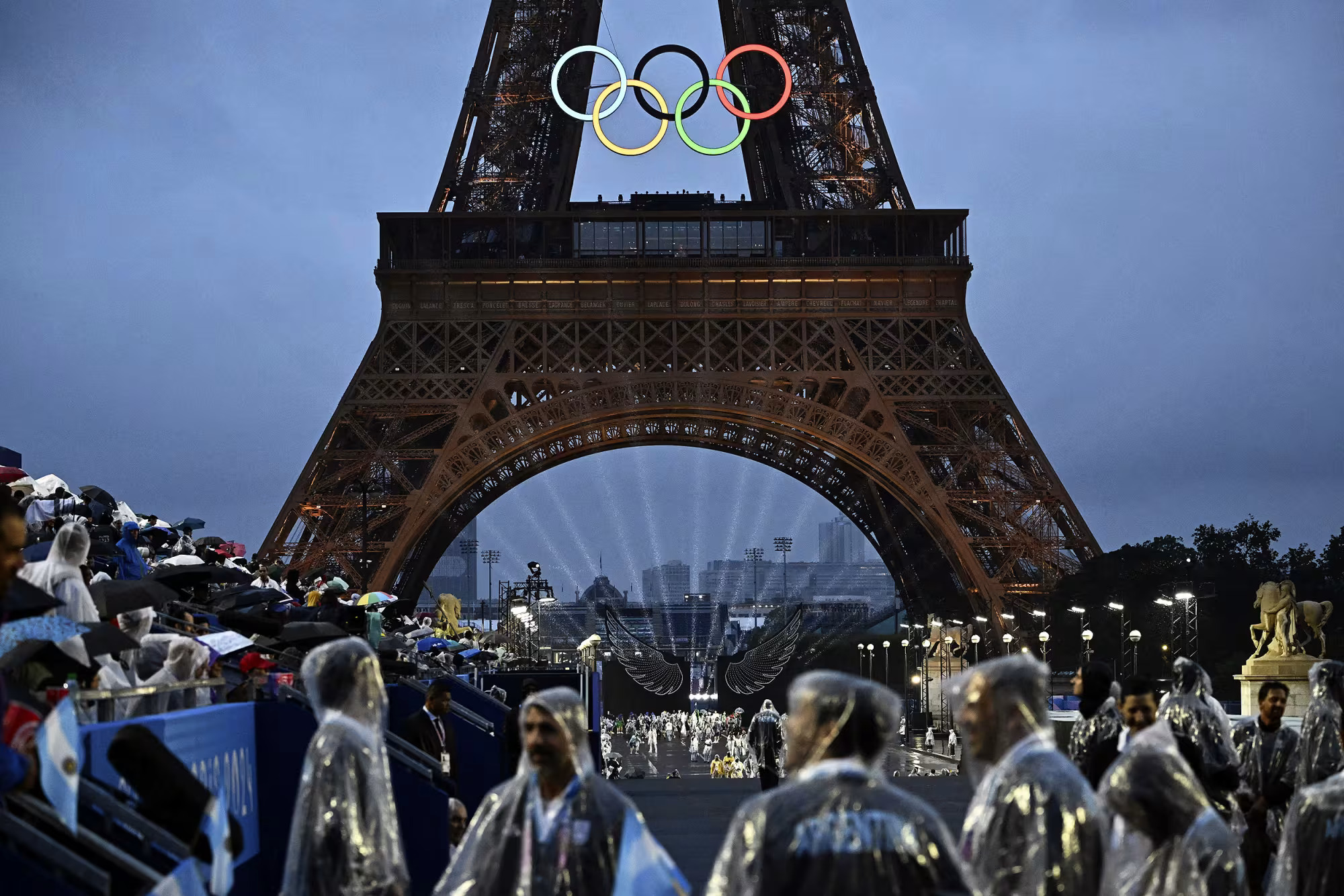
Following all of the pre-Opening Ceremony frenzy, today was, generally, a non-competition day (there were some shooting events) as anticipation built for a spectacular evening celebration along the Seine. Few will be unaware of the issues that dogged so innovative an Opening – the first ever to have been held outside of an Olympic stadium – and the vision of its creators was nothing short of remarkable and expansive. But, highlighted by performances from Lady Gaga and Celine Dion, when the Olympic cauldron was lit by former track star Marie-José Perec and judo legend Teddy Riner, it was an inspiring, uplifting, unforgettable occasion that set the stage for the catalog of inspirational athletic performances that are set to unfold over the next two-plus weeks. Sixty-three NYAC athletes will be in the heart of the fray, each writing their own page in the history of the Olympic Games and of the New York Athletic Club. We will follow all of the action here. Make sure to check back often. The Games have begun.

James O'Brien

An NYAC Medal Bonanza

An NYAC Medal Bonanza

Yesterday may have been the official opening of these Olympic Games – even though some events had already taken place – but, in reality, today is Day One. This is the day on which competition kicks into high gear and on which the intensity goes from level one to level 101; where, for many athletes, all of their Olympic dreams can come true, or the work of a lifetime comes undone, the victim of a momentary lapse. That is the terrible beauty of competition, magnified one thousand fold when the eyes of the world are on you, such as they are at the Olympic Games.

The eyes of the world were on the La Défense Arena this evening, that being the venue for the Olympic swimming competition and the first opportunity during these Olympic Games in which NYAC athletes could strike for gold.

Allow me to make a correction. The real first opportunity for hardware came during this afternoon’s women’s cycling time trial for which, remarkably, the Club’s Taylor Knibb, a triathlete first and foremost, had qualified and in which she was a powerful medal contender. Without question, Knibb is a remarkable athlete and a ferocious competitor, facts made evident by her ability to qualify for two sports in the same Olympics, an almost unprecedented feat. To reach such heights courts a significant element of risk – of injury, of burnout, of illness, of unforeseen elements that can derail the best laid plains; this is the currency with which an athlete of this caliber deals.

So it was for Knibb today. It rained, as it had unceasingly since yesterday evening when it teemed upon the tens of thousands along the Seine watching the Opening Ceremony. For cyclists at full intensity, rain means more than just getting wet. It renders surfaces treacherous. Two riders ahead of Knibb wiped out on the ice-slick roads. The NYAC woman did so three times, to the point that she damaged her bike and had to be delivered a spare mid-race. Making a bad situation worse, the tech delivering the bike from the support vehicle also slipped and fell. Thankfully, the bike was OK. Oh right; yes, thankfully, the tech, too.

The upshot was that Knibb’s hopes of a remarkable Olympic medal-winning double were dashed; she placed 19th in a time of 43:03.46 to the winning 39:38.24 of Australia’s Grace Brown. This does nothing, of course, to dull the patina of the fact that Knibb had qualified for two different sports in the same Olympic Games, an almost unheard of accomplishment. That was not done without mettle.

“I wanted to have the best race possible,” the NYAC woman commented, her legs bruised and bloodied from the falls. “You can only control what you can control. My race was going well, and then it wasn’t. I am just grateful to be standing and still walking. The first third was great. The middle one, that’s where it all went wrong. The third one was more survival than anything else. I was fully blind. My Garmin fell off on the first [fall], so I was like, ‘Well, here we go.’ One thing I have learned in my triathlon career and my brief time trial career is that I love learning. That makes me hungry.”

If you want to know what a competitor looks like, take a picture of Taylor Knibb. She goes in her primary event, the triathlon, on Wednesday (July 31st).

That was the heartbreak; what about the heroes? They came in the aforementioned La Défense Arena; more specifically, in the swimming pool of that venue, where no fewer than four NYAC members were in action, one in a semi (Nic Fink in the men’s 100m breaststroke) and three in finals: Paige Madden in the women’s 400m freestyle, Kate Douglass in the women’s 4x100m freestyle and Hunter Armstrong in the men’s 4x100m freestyle.

Fink got the job done in perfunctory fashion, securing a comfortable second place (59.16) behind Great Britain’s world record holder, Adam Peaty (58.86). The final of that event goes tomorrow (Sunday, July 28th) at 3:44pm EST.

In the women’s 400m FS, Madden contested powerfully for medals early on, but ultimately placed a still valiant sixth in a time of 4:02.26, to the winning 3:57.49 of Australia’s Ariarne Titmus.

There is something about relays that always lights the fire, even if you’re not rooting for anybody in particular. Relays are thrillers, especially so this evening in the pool, as the NYAC had representatives in both finals of the women’s and men’s 4x100m freestyle. Given that these athletes are swimming as fast as many people can run – just watch the judges at poolside – it is understandable that the events are rife with competitive tension.

In the women’s race, Kate Douglass, a denizen of the Travers Island pool, was the athlete on whom all NYAC attention was focused. She did not disappoint, taking the lead-off leg and setting the team up for a magnificent silver medal, 1.28 seconds down on the winning team from Australia (3:28.92 to 3:30.20). Douglass is also contesting the 100m freestyle, the 200m breaststroke and the 200m IM. Do we smell more metal in the water?

Hunter Armstrong was next up. Having just seen his NYAC teammate secure hardware, he was not to be cowed; on the contrary, the NYAC man was on fire, handling third leg duties, and producing a stellar split of 46.75 seconds to solidify the USA’s gold medal position. In fact, for the NYAC, this was a two gold medal night: Ryan Held raced in the heats, so he, too, earned a gold by virtue of his contribution to the team.

In judo, Maria Laborde came out powerfully in her first bout in the -48kg division, defeating China’s Guo Zongying by scoring waza-ari (half point) at 1:07 into the bout, followed another waza-ari at 3:11 to clinch the victory. That earned the NYAC woman a match against this year’s world championships silver medalist, Assunta Scutto of Italy. Laborde and Scutto battled for over three minutes before the Italian gained the upper hand, pinning Laborde for an ippon 3:23 into the bout.

The US rugby sevens team was also in action today, playing in the rounds to decide places five through eight in that tournament. With two NYAC players on the team – Perry Baker and Steve Tomasin – the Club had had a high profile throughout this series. And while the team performed impressively, with Baker setting a record for most tries scored in a single Olympic match (four) and for most tries scored in an Olympic tournament (10), the US fell at the hands of Ireland this morning (17-14) and to Argentina this afternoon (19-0), leaving the brave Eagles in eighth place overall.

In rowing, the US women’s quadruple sculls crew, with Teal Cohen in the boat, finished fourth in the second heat and will now race in Monday’s repechage. The US foursome dropped to fourth off the line and was still within contact of a qualifying position as the crews approached the halfway point. However, the foursome was unable to keep pace over the back half, as Great Britain pulled away for a comfortable victory ahead of Germany. In the repechage, the US will meet China, Switzerland, Romania, and Australia.

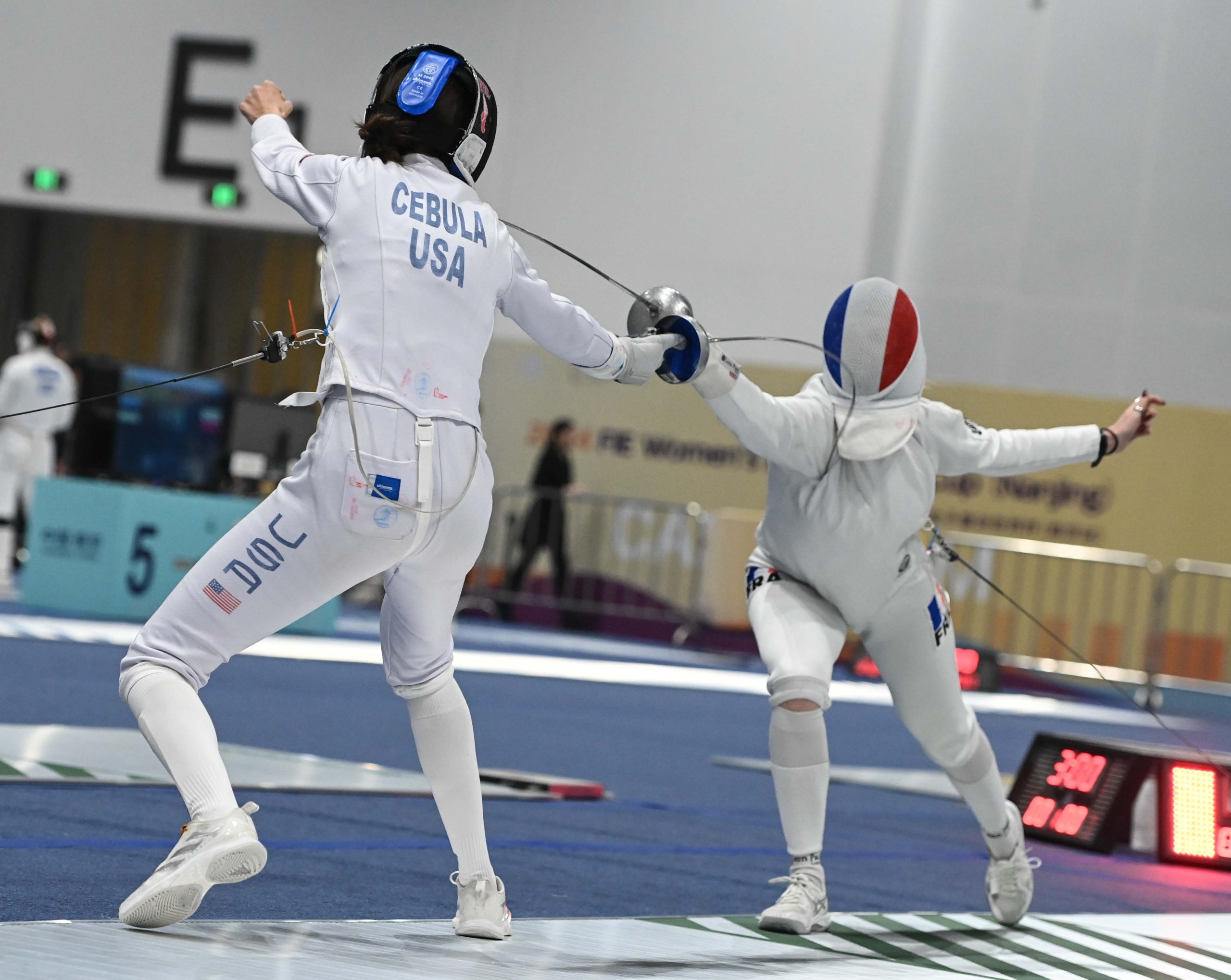
There was still more. In fencing, Anne Cebula (épée) and Mitchell Saron (saber) were on the strip for the opening rounds of their competitions. In the round of 32, Cebula scored a superb 15-14 win in priority overtime to defeat 2016 Olympic silver medalist Rossella Fiamingo of Italy, thereby advancing to the round of 16, where she met defeat at the hands of Auriane Mallo-Breton (FRA), 15-13. Mallo-Breton would go on to claim silver in the competition. In his opening round contest, Saron defeated 2022 World Championships individual saber silver medalist Maxime Pianfetti (FRA), 15-12, despite the overwhelming cheers from the pro-France crowd. The round of 16, however, was as far as the NYAC man could go, giving best to the top seeded Ziad El Sissy (EGY), 15-13.

So came to an end an enthralling first day of competition at these Olympic Games. A stunning 27 NYAC athletes competed, three claimed medals, and all brought acclaim to the club that is proud to call them its members. In total, 63 NYAC athletes are competing in Paris; already the medal count has begun; and the best – meaning more superb competitions – is still to come. The world’s greatest athletic club or what?

James O'Brien

Fink Takes Silver, Fourth NYAC Medal of the Games

Fink Takes Silver, Fourth NYAC Medal of the Games

To say that the NYAC’s swimmers are burning up the water is to understate the case. Last night, in the Olympic aquatics center, Kate Douglass (silver), Ryan Held and Hunter Armstrong (both gold) added to the Club’s fabled medal trove. (Read yesterday’s blog for all the details). This evening, back in the same venue, Nic Fink, contesting the 100m breaststroke final, continued that theme, securing a spectacular silver in a race that saw world record holder, Adam Peatty (GBR), attempt to claim a third consecutive Olympic gold.

That being the case, this was a high profile race, one within which the NYAC man thrived. Powerfully out of the blocks, at the halfway mark Fink was shoulder to shoulder with Peatty, Italy’s 2022 world champion Nicolo Martinenghi and China’s Hiyang Qin who, amazingly, in 2023 became the first man ever to win all breaststroke distances at the same world championships. As the swimmers made the turn for the home stretch, Qin faded badly as Peatty, Martinenghi and Fink powered for the wall. Peatty was the sentimental favorite; but, it was Martinenghi who had the deadly combination of strength and speed, making the final touch with 0.02 to spare, his time a comparatively slow 59.03. But who had claimed silver and bronze?

Peatty was right there, denied his third gold, but only by a hair. So was Fink, who, not to be forgotten, is the reigning world champion. It took the camera to sort it out and to determine that, in reality, neither had prevailed, both touching the wall at 59.05 and, thus, both earning silver medals. Spare a thought for Germany’s Melvin Imoudu in fourth, who may have thought, “Oh! Maybe I get a bronze.” Sorry, Mel. That’s not how it works.

Fink’s silver was a magnificent accomplishment and, it must be said, further evidence of the NYAC’s emergence – actually, re-emergence – as a swimming powerhouse.

It should also be noted that Hunter Armstrong, gold medalist from last night, was in the pool again this evening. He contested the 100m backstroke semi-finals, placing fifth in the second semi, but missing out on a place in tomorrow’s final.

There was a ton of other NYAC Olympic action today. Not as much as yesterday, when we saw 27 NYAC athletes competing in seven sports. Today it was “only” 10 athletes in four sports, those still being numbers to evoke envy among many national federations.

In judo, Angie Delgado (-52kg), competing in her third Olympic Games, faced a war in her opening contest against Gultaj Mammadaliyeva from Azerbaijan. With two penalties apiece at the bout’s conclusion and with neither having gained an advantage, golden score was the next phase, meaning the first to score wins; no time limit. That went to the NYAC woman, who threw Mammadaliyeva for waza-ari (half point) after 3:04, thereby advancing to the round of 16.

“We know each other so well,” Delgado commented of Mammadaliyeva. “We compete maybe 10 to 15 times a year between training camps and everything. It was good to fight someone I know really well and I had a game plan for her.”

In the round of 16, Delgado faced Odette Giuffrida from Italy, the 2024 world champion. Uh-oh. But the NYAC woman was aggressive from the outset, as she had been in her first bout, and, again, the contest went to golden score. This time it was the world champ who prevailed, scoring a half point after 2:28 and claiming her place in the quarter-finals. It is a brutally effective and clinical way to decide an Olympic outcome; but, that’s how it works.

“I felt really good today,” Delgado reflected. “I felt like if I could have gotten past her, I definitely would have got a medal. Going into overtime, I was catching her a couple of times, but then she pulled away the last two minutes of golden score. We compete maybe 10 to 15 times a year, and I’m the oldest one in the division now. So I’ve gotten my hands on all these women, and I know them like the back of my hand. I knew exactly how she was going to come out, and I was just trying to see what my game plan was, but it didn’t work. I’ve dedicated my whole life to this. I’m 33 now, I started when I was nine. So that’s my whole life. I’ve dedicated myself completely to the sport. I make sure to tell everyone that if you really want something, you will find a way. And I found a way to make it three times to the Olympics because I always wanted that Olympic medal. I’m not going say that I’m going to sleep easy tonight because this one’s going to hurt for a while, because I don’t know if I’ll be back here. You never know. But I can say that I really gave it my all in everything that I did.”

The disappointment was evident on Delgado’s face and in her voice. Hopefully, she can take solace in the fact of having fought like an Olympic champion.

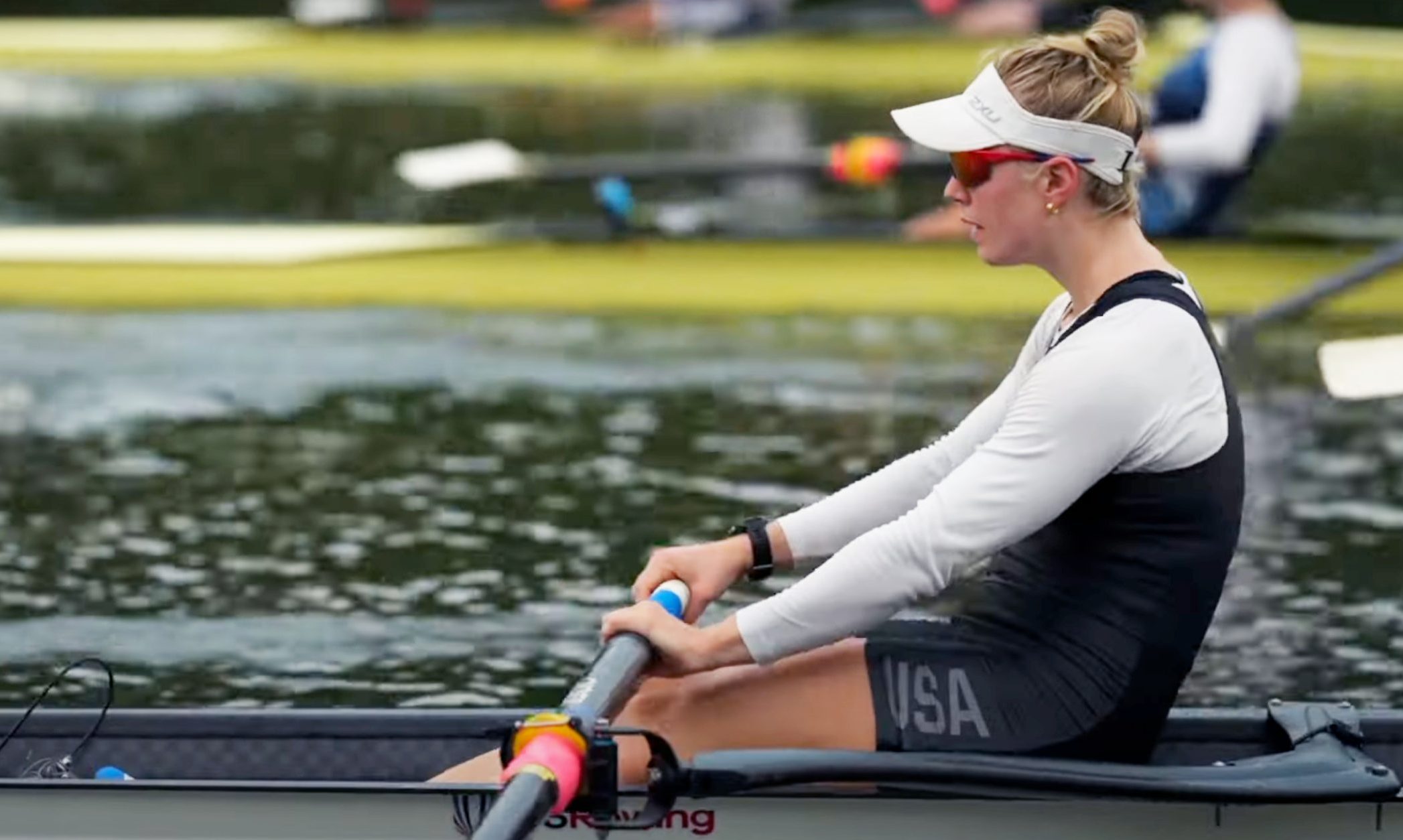
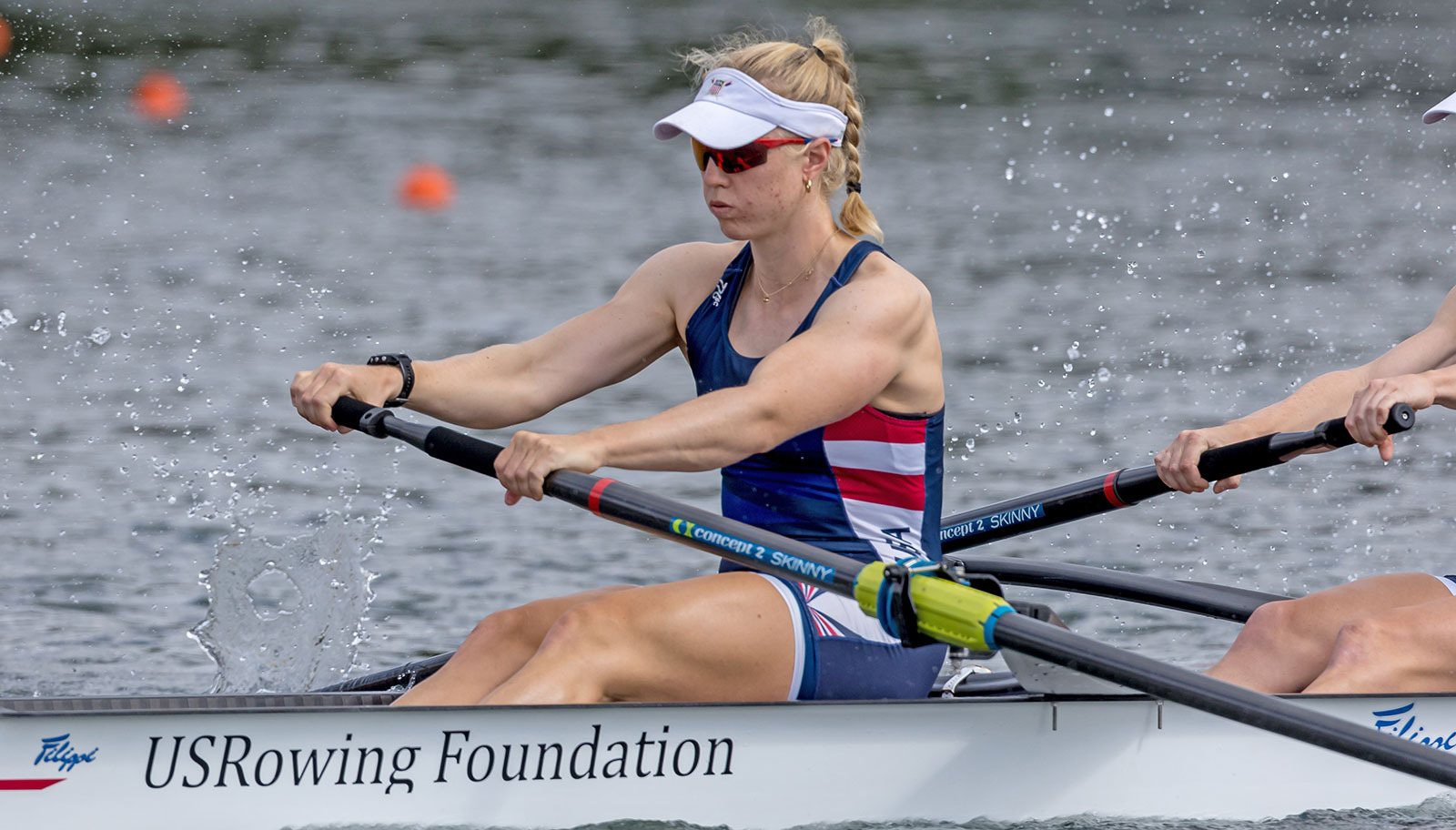
At the rowing venue, the Vaires-sur-Marne Nautical Stadium, heats took place this morning for the women’s lightweight double sculls and the men’s and women’s fours. Molly Reckford in the lightweight double sculls was first on the water, paired with her long-time partner, Michelle Sechser (non-NYAC) with whom she had placed fifth at the Tokyo Games three years ago. Reckford and Sechser made this outing perfunctory, staying a comfortable second throughout the race and advancing to semi-final B behind a powerful Romanian team (7:03.83 to 7:12.65). That event takes place on Wednesday (July 31st) at 11.44am Paris time (5:44am EST).

Next up came Kelsey Reelick in the women’s four. The first two finishers would advance directly to the final, but it was clear early on that the US boat was going to have problems. As the intimidating squads from Great Britain, New Zealand and China forged ahead (they finished in that order), Reelick and her boatmates had to settle for fourth (though they rapidly closed on China over the last 500m). That placing means that we will next see Reelick in the repechage, which takes off on Tuesday (July 30th) at 11.30am Paris/5pm EST.

That left Nick Mead as the last NYAC member on the water. In his outing, he and his three colleagues left nothing to chance, dominating the race and scoring an almost two second victory (6:04.95 to 6:06.84) over an always intimidating Australian crew. Both boats advanced directly to the final, scheduled for Thursday (August 1st) at 12.10pm Paris/6.10am EST. That one is certain to be a nail-biter, with world record holders, Great Britain, also having moved on to the medal round.

From one body of water, I next turned my attention to another, this one being indoors, the Aquatics Center, by name, site of the preliminary rounds of the water polo competition. (The medal rounds are being held in the La Defense Arena-Nanterre. No idea why. Presumably, bigger; that’s also the venue for swimming). Much of the conjecture in the NYAC world has been focused on the US women’s water polo team, which is entirely composed of Club members and which is seeking to claim its fourth consecutive Olympic gold medal. Its understandable why that narrative should garner such plentiful attention; but, let’s not forget the US men, with four Club players in the squad: Alex Bowen, Hannes Daube, Max Irving and Alex Obert. The last time that the USA men claimed an Olympic medal was in 2008, when the team earned silver. It will be an uphill battle in Paris for sure; but, aren’t Olympic medals supposed to be difficult to earn?

All of which preamble is to explain where I am right now, meaning in the aforementioned Aquatics Center, awaiting the first outing of the US men, who are about to clash with Italy, who won this competition all the way back in 1992. With the game underway, from the outset, it was a pitched battle. The US scored first, Italy equalized. The US gave away a penalty – the goalie being excluded – allowing Italy to take a 2-1 lead, which they quickly extended to 3-1. Both teams added one more, leaving the score at the end of a bruising first quarter at 4-2 in Italy’s favor.

The US was the first to open the scoring in the second quarter with Alex Obert blasting a rocket into the Italian net. Some stellar defensive play from the US and a clutch of remarkable saves from goalkeeper Adrian Weinberg proved enormously frustrating for the Italians until they put one in the US net with just 10 seconds remaining in the second quarter. So, half way through the battle, the score stood at Italy 5, USA 3.

Things opened up in the second half, with both teams scoring quickly, the US goal coming courtesy of Alex Obert. But the tide was inexorably turning, to torture an aquatics metaphor, and as things progressed it became ever more clear where the balance of power lay. The Italians were relentless, if not merciless, and at the end of this third round had placed an indelible stamp on the game, widening the margin to 9-4.

In the fourth round, Italy scored quickly once again. A response came from Hannes Daube, his third of the match; but, with the score now at 10-5, the signs were ominous.

Things did not change in the dying minutes of the match and, even though the US managed to put one more score on the board within the final 30 seconds, the writing on the wall, if not on the scoreboard (12-8), told a plain story: in a group that includes world champions Croatia, plus Greece and Montenegro, the US squad has got a fearsome challenge ahead. However, repeating my previous observation: it’s not supposed to be easy.

It is sobering to consider that, with just two days of competition completed in these Games – begging the forgiveness of the rugby sevens guys, who began their competition before the Games proper began – the NYAC has already claimed two gold and two silver medals. For many countries that would be enough; the job is done, let’s go home. For this club, however, for the New York Athletic Club, that is far from the case. For this club, these Games are just beginning.


James O'Brien

No results found.