
Sensational Sarah
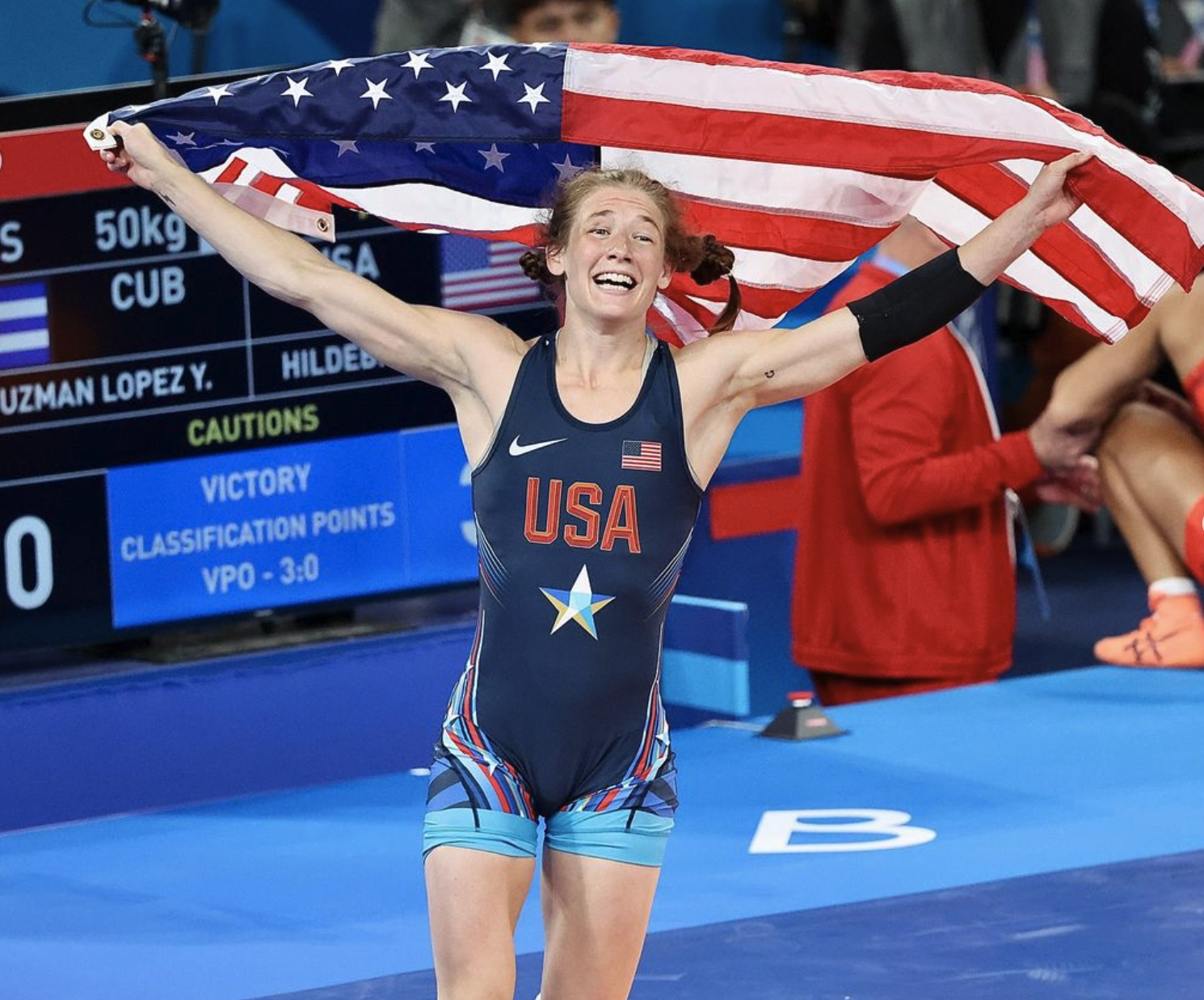
Today was a magnificent day for the NYAC, though it started off in a manner that could not have been anticipated. Both sides of that coin related to wrestler Sarah Hildebrandt. And, spoiler alert, it culminated in a magnificent and historic victory for the NYAC woman, one that will long be remembered by those privileged to see it.
We should know by now to expect the unexpected when it comes to the Olympic Games or, indeed, to any major sporting event. In Paris, some days it is pollution in the Seine that finds its place on the front pages, other days it is gender issues in the boxing competition. Today, it was the disqualification of Vinesh Vinesh (aka Vinesh Phogat, apparently) in the women’s 50kg wrestling competition, she being the woman that Hildebrandt was scheduled to face in this evening’s gold medal bout.
Vinesh (I’m using her surname here) had already caused a sensation in her home country, by becoming the first Indian woman ever to make an Olympic wrestling final, which she did in dramatic fashion, first unseating the prohibitive favorite, Japan’s Yui Susaki, the four-time world champion, in the round of 16, and then taking down former European champ Oksana Livach of Ukraine in the quarters. That set her up for a semi-final bout with Cuba’s Yusneylis Guzman Lopez, the reigning Pan Am Games champion, which the Ukranian dominated, securing a 5-0 victory. Hildebrandt won the other semi, being similarly dominant over #2 seeded Otgonjargal Dolgorjav of Mongolia and setting the scene for an epic battle for the gold medal: Hildebrandt, the bronze medalist from Tokyo, versus Vinesh (surname) the woman ushering in a new era in Olympic sport for India.
That is, until this morning when the news broke that Vinesh had been disqualified for failing to make weight. Although she was within bounds for yesterday’s semi-final, the Indian woman, whose natural weight is, reportedly, closer to 56kg, rebounded and added approximately 2kg after the match, something not unheard of in wrestling circles, where athletes go to enormous lengths to ensure they are within bounds for the weigh-in and then strive, until the actual bout, to regain any strength and muscle mass that they may have lost during the weight loss process. It is an arduous, sometimes torturous process. So, Vinesh rebounded, but to too great a degree.
Reporting on one of the biggest Indian stories from these Games, the Hindustan Times stated that Vinesh’s coaches and support staff went into high gear to ensure that their wrestler would be below the line of demarcation this morning. The measures allegedly included, cutting her hair, forcing her to stay up all night in order to induce stress, abstaining from food and drink for 12 hours, running, skipping and cycling and, remarkably – and, again, allegedly – drawing blood. All of it was in vain and, at this morning’s weigh-in, Vinesh was found to be 100 grams over-weight. For those imperialists among us, 100 grams is 0.2lbs, about the size of one not very big tomato. Reportedly, Vinesh then suffered from dizziness, lost consciousness for a short while and was brought to a hospital, where she received IV treatment for dehydration.
What this all meant was that Vinesh was disqualified, not just from the final, from the entire competition. Even though she had made weight for the semi, that result is deemed null and void and she goes to the back of the list, reported as having scored zero points in this tournament. The woman she beat in the semi, Cuba’s Guzman Lopez, was upgraded to fight Hildebrandt for the gold medal; and what was to be the repechage between Susaki and Livach was amended to be the fight for the bronze medal.
It was a strange and troubling – though not unprecedented – development on many levels; though that is a conversation for another day. For the here and now, it begged the question of how this would affect the dynamic of the bout about to begin. Following her superb semi-final victory, Hildebrandt, presumably, had spent the last 24 hours preparing physically and mentally to face Vinesh and whatever strengths and weaknesses the Indian woman may have brought to the mat. Similarly Guzman Lopez, having thought she was going to face Susaki, then found herself up against an entirely different competitor in what, presumably, was the biggest competition of her life, and with just hours to prepare.
In reality, both Hildebrandt and Guzman Lopez are highly experienced competitors and not easily swayed by the vagaries of competition. In fact, this is what they train for, day after day after day, for years. From the opening buzzer, therefore, it was clear that they were both here and both ready for the day that they had been preparing for for their entire lives.
One striking element throughout this competition has been how relaxed Hildebrandt has been, how she has complemented the intensity of her bouts with the appearance of enjoyment. It has been as though, when she appears on the mat, at that moment in time, there is nowhere else that she would rather be. That sentiment was in plain sight in the gold medal final. That she had to work hard to keep from smiling, was in stark contrast to the burning aggression – or was it trepidation? – that was manifest in the comportment of Guzman Lopez. But all questions were answered once the whistle blew to get this bout underway.
Ironically, Hildebrandt was first penalized for passivity, to which she responded by putting an immediate two points on the board, quickly followed by another one, when Guzman Lopez was penalized for not being able to score once she, too, was also called for passivity. Wrestling is a complicated game; “physical chess,” so dubbed by Hildebrandt.
The first three-minute period came to an end with the score unchanged; 3-0 in Hildebrandt’s favor. And still she was relaxed, engaging, clearly just loving being where she was in that moment. In that, she was the picture of an athlete at the height of his or her game, at the peak of their prowess. Mark Spitz, Lasse Viren, Nadia Comaneci, Michael Phelps, Carl Lewis – they have all seen that pinnacle. Today, Hildebrandt joined them.
In the second half, it was more of the same; which is not to imply tedium. On the contrary, Guzman Lopez attacked Hildebrandt with the will to unseat her from her prime position. The Cuban attacked with all the speed, strength and experience that she has gleaned through 1000 hard-fought bouts. Her problem was that, today, Hildebrandt seemed to draw on 1001 bouts that were faster and stronger and from which she had gained more experience. The score was unchanged in the second half, and as the clock progressively wound down to the, seemingly, inevitable conclusion, the cacophony in the arena built and built and built to the deafening roar that proclaimed the NYAC woman as the Olympic champion.
As Hildebrandt exulted in her victory, it was as if an amalgam of sport and art had produced a perfect moment in time. Hildebrandt raised her arms in victory, then embraced her opponent in a moment of genuine camaraderie, then rejoiced with the crowd, and it was as if this was the picture of what Olympic sport should be, and was, and probably is if we look closely enough. For this moment in time, it was enough to accept it for its sheer face value: a superb victory by a superb athlete, a superb NYAC athlete.
“My mind and body are not computing everything,” commented the new Olympic champion, “especially with the chaotic morning I had with the change of opponent. It has all been crazy. Mostly, I feel gratitude. I just want to go and squeeze my family.”
Hildebrandt contemplated the morning’s peculiar turn of events. “I prepared for chaos, but this was not on my bingo card of chaos. [Vinesh] was not at weigh-ins. Then, we get the news that she didn’t make weight, and we were under the impression that it was a forfeit. So, there was a lot of celebrating. It was very strange: ‘Oh my god, I just won the Olympics.’ Then, an hour later, they were like, ‘You didn’t win the Olympics.’ I thought, this is very weird. So there had to be a reset. I took a nap, woke up, and it was like a fever dream.”
Or maybe a dream come true.
Other NYAC action today could hardly compare to the drama of Hildebrandt’s win, but the US water polo team did its best to come close. Today, the US men faced Australia in the quarter-final rounds, a do or die bid to close in on the medal placings, a position the squad has not seen since 2008. Here in Paris, the American squad, with four NYAC players on board, advanced third in Group A, having won three and lost two of their matches. Australia, in Group B, had logged the same tally, but finished second. The only thing clear as the game began, therefore, was that this one could go either way. At the world championships in Doha, Qatar earlier this year, the USA finished ninth and Australia 11th; so, not much there to assist in determining the odds.
Australia was first to open the scoring, notching their first with just about two minutes gone. The US quickly responded, indicating their intent to make this anything but a one-sided affair. But Australia soon regained the upper hand, all the more so once the USA’s Johnny Hooper punched one of their guys right in the face, giving away a penalty and earning himself a red card. The Aussies seemed to think it was hilarious; pain is not really something to which water polo guys pay much attention. Plus, they ended the quarter 3-1 up, so good reason for them to be happy.
In the second, they continued that momentum with two quick goals that stretched their lead to 5-2, though the US clawed one back with just 22 seconds remaining, leaving the half time score at 5-3 in favor of Australia. Still a long way to go.
With possession fairly even on both sides, the USA clawed back a precious score two and a half minutes into the third quarter, then took advantage of an Aussie error to blast home a penalty courtesy of the NYAC’s deadly Hannes Daube. With no room for further mistakes on either side, you had to say that this was nail-biting time. At the end of the third, it was 5-5. Eight minutes remaining and it was as if this was a final for all the marbles, right here.
It was two minutes into the fourth when Deadly Daube struck again with a rocket that gave the Australian goalkeeper not a hope. With the score at 6-5, the roars of ecstasy from the US fans caused a mini-tsunami in the water. But there was no time for swimming on laurels. A significant Australian error saw their man Charlie Negus get a red card and departure from the water (though with a sub permitted minutes later); but, playing with a man down is not where you want to be with three minutes left in an Olympic quarter-final.
Still, the Aussies were relentless to the point that, with just under three minutes remaining they pressed into the US goal mouth and launched one past goalkeeper Adrian Weinberg that evened it at 6-6. Momentum is often what makes the difference. With two minutes remaining, Australia put another one in the net, taking the score to 7-6. Not surprisingly, the US called a time out with one minute remaining, this, in no uncertain terms, being the tipping point, do or die, advance or go home. No pressure.
With 32 seconds left on the clock, the NYAC’s Alex Bowen showed that he understands that great things are expected. With the US crowding the Australian zone, he shot like a sniper, a goal that was scored the second that it left his hand. It was going nowhere but the back of the net. With the score at 7-7, Australia called its own time out. Imagine: 32 seconds to go in an Olympic quarter-final and it’s all even. So, now what? Time runs out and it’s down to penalties, five each. As if things weren’t fraught enough.
Initially, it was even up. Daube and Max Irving both scored on their attempts, as did the Australians. The Aussie’s third shot was blocked, giving the USA a precious advantage. Alex Bowen scored the next one, bringing the score to 3-2 to the US. Both sides had their next two saved, meaning that, with one shot each left, if Australia scored, the US could not afford to miss. Australia did score. And the US did not miss, bringing the conclusion of an epic battle to a final score of 11-10 in favor of the USA. It was a match that both sides will long remember, thankfully with the correct result. US women’s goalkeeper, Ashleigh Johnson, encapsulated it perfectly yesterday: “From here on out, they’re all finals.”
Next, the US men face Serbia in the semi-final on Friday (August 9th). The winners of that go to the final; the losers go to the bronze medal match. This is seriously starting to get serious. Seriously.
The only other NYAC action today was in track and field at Stade de France. US champion, Maggie Malone-Hardin, appeared in the qualifying round of the women’s javelin, her third appearance in an Olympic Games. The outcome was disappointing, however, as, clearly below her best, she reached just 58.76m/192-9, a mark that saw her 24th overall and well over two meters shy of advancing.
Malone-Hardin may have been disappointed, but she is far from disappointing. On the contrary, her Olympic performance is part of a continuing NYAC narrative, one in which her story is written alongside that of Sarah Hildebrandt, of the NYAC water polo players, and of every athlete that has worn the winged foot and embraced the mandate that “great things are expected of you when you wear the winged foot.” Those great things don’t always occur on the same day.