
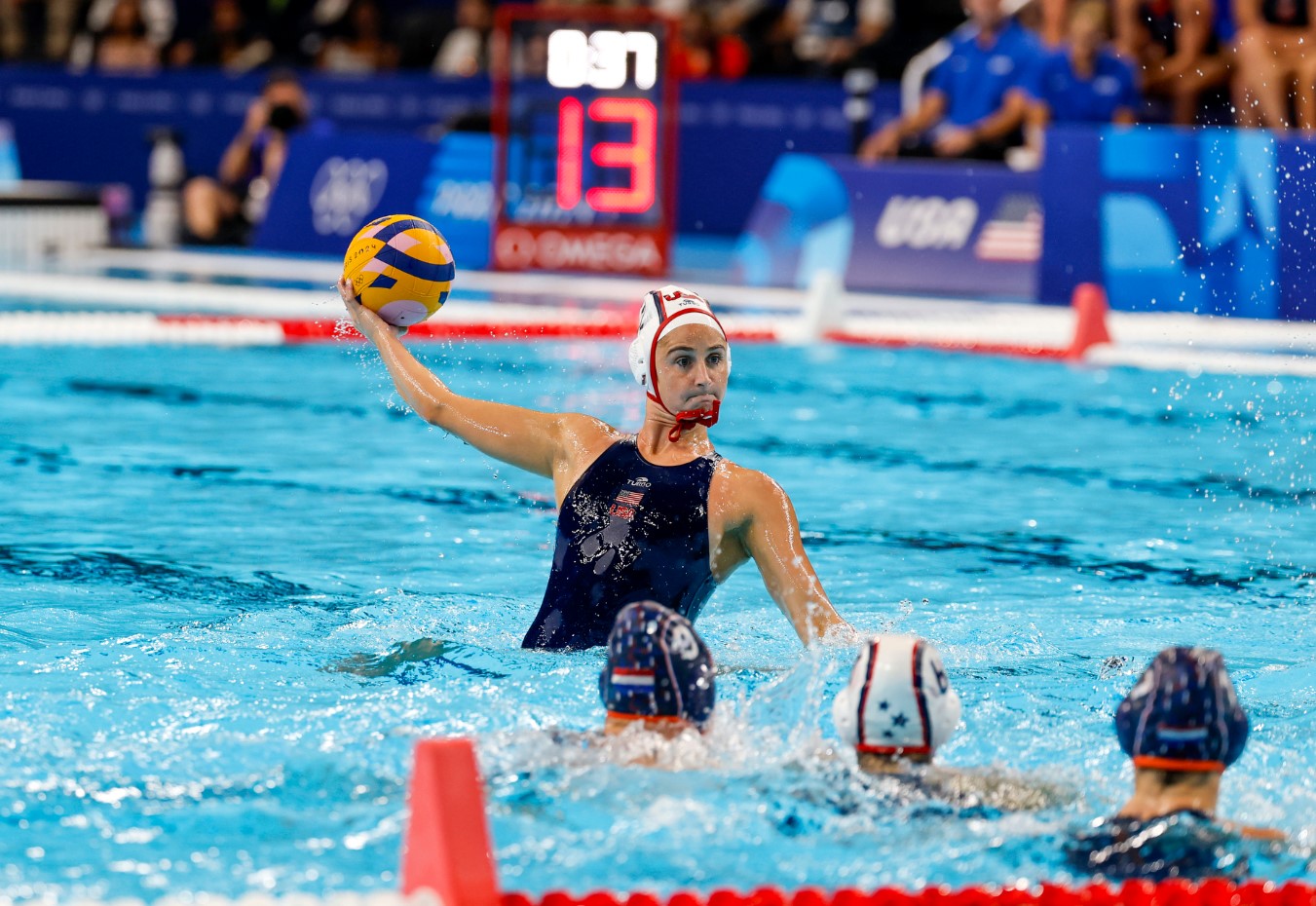
A Single Second Makes All the Difference
Today was just brutal. Brutal. No other word for it. Well, actually, there are dozens more words – heart-breaking, devastating, dispiriting, traumatic. Choose your own. But, brutal, that pretty much says it. And, savage.
Picture this: you’re the gold medal favorites in your sport. In fact, you’ve won it all for the previous three Games, and here you are going for an unprecedented fourth. In fact, since the addition of your sport to the Olympic program in 2000, you’ve never failed to win a medal of some description. Then, your dreams of a fourth gold are shattered by a powerhouse team that dispatches you from the semi-final into the bronze medal match. OK, disappointing, but hardware is hardware and, for some, that would be a spectacular accomplishment. So, a change of focus, that’s all.
And in that bronze medal match, all is going to plan. Going great, in fact. You’re in control, in the lead, all looking good. Until it just isn’t. Until your opponent claws their way back in the closing minutes to make it even. And then, with one second remaining – literally ONE SECOND – they hammer home the score that tells you, no, you didn’t win the fourth gold medal that you coveted; no, you didn’t get the bronze medal; and, yes, for the first time ever, you didn’t return home with any hardware at all. And it all slipped away in one single second.
Maybe there is a lesson for life in there somewhere. Success can hang by a thread, fortunes can change in the blink of an eye, and the difference between victory and defeat can be as subtle but impactful as that butterfly that flapped its wings in Europe and caused a tsunami in southeast Asia. It puts one in mind of Rudyard Kipling’s cautionary tale: “If you can meet with triumph and disaster and treat those two imposters just the same.” (If you don’t know that poem, “If,” get out your Google machine and read it. It may be the 30 seconds that changes your life. Granted, you may not want your life changed; I digress).
All of the above may sound like fiction, a horror story; sad to say, it is not. It is precisely what happened in the water polo arena this morning when the US women faced the Netherlands to decide who would take home the bronze medals from this tournament. Yes, the US had won the previous three, and, yes, they had never failed to take a medal of some color from an Olympic tournament; so, yes, they were justified in having a degree of optimism coming into Paris, and justified in being disappointed and, to no small degree, shocked, when Australia held them equal at full time in the semi-final, then beat them on penalties to end their gold medal hopes. But, still, there was today and a degree of redemption. Until there wasn’t.
“I thought we started off great, exactly the way we wanted to start,” commented Maddie Musselman afterwards, clearly riven by disappointment. “We even talked about the momentum that [the Netherlands] can get, and being able to stop it. And somehow we just weren’t able to do it. I think it was a lapse of focus, something we’ve repeatedly talked about and couldn’t get right.”
For Musselman, an integral member of the team, it was remarkable that she was here at all; her husband is struggling with lung cancer. So, perspective is all. She continued, “Going into the Olympics I told myself I wanted to enjoy every minute of it, and I did. It’s easy to look at your results and define that journey by that result. But I enjoyed every step along the way. I’m happy for where I am right now.”
Maggie Steffens, a member of all three previous winning US teams, concurred: “It’s all about the journey; the destination is a byproduct. It’s difficult that the destination, the goal and the mission weren’t completed. But the journey is everything, the team is everything.”
Time for more Kipling: “If you can make one heap of all your winnings, and risk it on one turn of pitch-and-toss, and lose, and start again at your beginnings and never breathe a word about your loss. If you can force your heart and nerve and sinew to serve your turn long after they are gone, and so hold on when there is nothing in you, except the will which says to them, ‘Hold on!’”
Let me repeat, this game was brutal.
At the end of the first, everything was cool. The US held a 3-2 lead with goals from Rachel Fattal, Ryann Neushul and Musselman. All good. Into the second, even better. With a turning of the screws, Jenna Flynn, Emily Ausmus, Kaleigh Gilchrist and Neushul all hammered scores home. The Dutch only managed one. So, now it was 7-3 and the universe was unfolding as it should. (Another amazing verse. Desiderata. Google that one, too).
But the universe started to unfold in a Dutch direction once the second half began. The US found the net twice, while the Netherlands put three scores on the board; 9-6 with one quarter, eight minutes of play remaining. Still looking pretty good; but momentum was building. Sabrina van der Sloot scored for the Netherlands within the first minute, bringing it to 9-7. Jenna Flynn responded: 10-7. Vivian Sevenich brought it to 10-8 and, 30 seconds later, to 10-9. Three minutes remaining, one goal in it. With 1:19 left on the clock, Bente Rogge pulled the Dutch even for the first time in the game. It was a score prompting a roar that shook the arena’s foundations. From the Dutch fans, it was jubilation; from the Americans, similarly raucous, but almost visceral pain.
Into the final minute, it looked like the US was going to find itself in a penalty shoot-out for the second consecutive game. Another nail biter. And then, it was all over. With a single second remaining and everybody thinking penalties, the unthinkable happened. The assassin van der Sloot was not thinking penalties. She was thinking, “This thing ain’t over until it’s over,” or whatever the Dutch equivalent may be. Unleashing a bullet that US goalkeeper, Ashleigh Johnson, had no chance of stopping, she moved the dial to 11-10 exactly as the clock ran out.
Truth be told, it was a thing of beauty, or would have been had it been the other way round. A spectacular come-back, mercilessly effected. Brutally, in fact. Just brutal.
Commented head coach, Adam Krikorian, “It was a big moment. It seemed a little too big at times, to be honest. One of the frustrating things for me is that everyone on the outside has no idea how difficult this is, how hard it is to win. We made it look easy, but it was anything but that for those three Olympic Games”
That, indeed, is a painful truth. A gold medal, in all its luster, reflects only the victory; it shows nothing of the trials, tribulations and obstacles overcome in order to get there. To be sure, losing can be hard; sometimes winning can be harder.
The other NYAC action today was a little easier on the nerves, though no less hard fought. The athlete in question was Jess Savner, who, unlike any other member of Team NYAC, had to contest not one, but five different disciplines. Savner was competing in the modern pentathlon, these days often referred to as simply the pentathlon, presumably because there is no longer a pentathlon competition in track and field with which to confuse it (except indoors) and also because it’s not that modern any more. As mentioned a day or so ago, the event first appeared at the 1912 Olympics in Stockholm; so, not so modern, these days.
The disciplines that Savner contested in Paris were running, swimming, fencing, shooting and equestrianism. Having a mother who was a professional horse rider would certainly have been an asset, though, by her own admission, Savner’s prime event these days is fencing, assisted by the top class instruction and competition in the fencing room in the City House.
The fencing classification events took place on Thursday (August 8th) at the North Paris Arena. At the conclusion of that day’s work, the NYAC woman held 21st position, having garnered 205 points, 55 shy of the leader, Elodie Clouvel from the home country. The bulk of events took place today at the spectacular Château de Versailles, with Savner having to place within the top nine in order to advance to tomorrow’s final.
Scoring in the modern pentathlon can be bewildering; but, in a nutshell, here’s how it broke down:
Show-jumping – ninth place, semi-final A (293 points)
Fencing bonus round – 12th place, semi-final A (209 points)
Swimming (200m freestyle) – 18th place, semi-final A (255 point)
Laser-run – 15th place, semi-final A (553 points)
Add those totals together and Savner placed 14th overall among all those in the A semis. Then, merge those overall placings with overall placings from the B semis, and Savner was 28th. Had she placed among the top nine in the A semis, she would have been on deck again tomorrow. As things stand, she now returns home a, hopefully, proud and gratified NYAC Olympian.
It is difficult to conceive that, now, after 18 days of competition – don’t forget, events began before the Opening Ceremony – there is only one day of competition remaining and only one set of NYAC athletes remaining to take part. The group in question is the US men’s water polo team which, tomorrow, goes face to face with Hungary in a bid to secure the bronze medal. Alex Bowen, Max Irving, Hannes Daube and Alex Obert are the gents who will be flying the NYAC flag and who will be seeking to add to the Club’s medal tally which, as of this moment in time, stands at 24. Broken down, it’s nine gold, 12 silver and three bronze. Those are some serious numbers and of which all NYAC members should be enormously proud. Every day throughout these Games, there have been highs and lows, none more so than today; but, the over-arching sentiment is success and excellence, as it should be. Twenty-four Olympic medals is a magnificent accomplishment, among the best in NYAC history. Even so, wouldn’t four more bronzes be very nice?