
Jones Makes History. Hildebrandt Moves to the Final.
I’m an emotional wreck, I admit it. Today’s NYAC action had all the thrill of victory and the agony of defeat, and plentiful landing places in between; and it can wear a person down, that person being me. I get invested in this stuff. To follow the ups and downs of our members at the Olympics can be a roller-coaster ride, one minute flying, the next diving. Through it all, and most compelling, is that our athletes, today and every day, compete like champions in this, the most intense athletic cauldron on the planet. Not all of them get to where they want to go; but all of them give all they have in the pursuit. And, as is said, “Ah, but a man’s (or woman’s) reach should exceed his (or her) grasp, or what’s a Heaven for?” (I’d love to take credit for that one, but a little googling will quickly reveal that it was Robert Browning). All of which is to say that today has some very special moments. But before we get to that, a little reflection on a swampy story that just won’t go away.
Namely, the issue of swimming in the Seine, a story that may be coming into an ever-sharper focus given that the marathon swims are scheduled for Thursday and Friday (August 8th and 9th). For the record, the marathon swim is 6.2 miles (pretty much one lap of Central Park, plus a bit more), meaning that competitors will stay in the water for a heck of a lot longer than did the triathletes. With that comes a commensurately increased risk of infection from E. coli. And try as they might, the organizing committee can do little to assuage the considerable concerns.
For example in explaining the cancellation of today’s marathon swim training session in the river, the official statement stated, “The water quality results reviewed today at 4am revealed E. coli levels at the four collection points on 5 August at 5-6am were considered “very good” (326, 387 and 411) for three of the collection points and “good” (517) for the remaining one. However, confirmation of a return to acceptable levels for Enterococci could not be made by 4am on 6 August. The latest samples available and reviewed at the time, which were taken between 12.30-13.20pm on 4 August, showed that levels remained above the thresholds accepted by World Aquatics.” The statement continued to explain the outcome of further tests before concluding, “These results, combined with the weather forecast and forward-looking analysis, allow Paris 2024 to remain highly confident that marathon swimming competitions will go ahead as planned on 8 and 9 August.”
All of which may lead to some head scratching and, it appears, the conclusion that the only course of available action is to keep one’s fingers crossed and hope that the stars align.
In this morning’s qualifying rounds of the women’s long jump, the NYAC’s Tara Davis-Woodhall didn’t need to rely on luck, the alignment of heavenly bodies or any such intangibles. She simply took two jumps, the second being an auto qualifying 6.90m/22-7¾ (the automatic qualifying mark was 6.75m/22-1¾), and, with her place in Thursday’s final secure, called it a day. Significantly, Davis-Woodhall’s qualifying mark was the longest of the day. That won’t mean anything once the medal round gets underway; but, there’s no denying that it’s a good sign and that the stars may be aligning, even though we don’t believe in that stuff. Davis-Woodhall won the silver medal at last year’s world championships, so there’s also that.
For Tokyo Olympic wrestling bronze medalist, Sarah Hildebrandt, today was the day on which she intended to repeat, or improve upon, that success of three years ago. As the day evolved, it seemed that the NYAC woman was on track to do exactly that, effecting two convincing wins in the 50kg division in the morning session, and advancing to this evening’s semi-finals.
The #6 seed, Hildebrandt opened with an impressive 10-0 technical fall over four-time African bronze medalist, Ibtissem Doudou of Algeria, before moving on to a commanding 7-4 victory over 2023 World Championships bronze medalist Ziqi Feng of China. Next came the semi-finals, and a face-off against the #2 seeded Otgonjargal Dolgorjav of Mongolia, a three-time Senior World Championships medalist, including silvers in 2022 and 2023. In their most recent meetings, the two have gone 1-1. In their most recent clash, at last year’s world championships, it was the Mongolian who came out on top.
Coming into this tournament, Hildebrandt, who likens wrestling to “physical chess,” stated, “When that whistle blows, I’m ready to fight. And I’ve got nothing but respect for somebody who shows up to do the same thing.”
Against Dolgorjav, the truth of that statement was evident from the outset that, especially the first part. Hildebrandt placed two points on the board within the first handful of seconds, assuming a control that she never relinquished. With a remarkable combination of powerful attacking and solid defensive moves, she was a wall of frustration for her opponent, who used every weapon in her considerable arsenal, all to no effect. At the end of the first three-minute period, the score stood at 5-0 in favor of the American. In the last three minutes, nothing changed; Hildebrandt maintained her dominance to the point where, with 10 seconds remaining, entangled with Dolgorjav on the mat, she broke into a broad smile, knowing that the deed was done and that she was going to tomorrow’s final (Wednesday, 7th) where the worst that will happen is that she will get a silver medal. Of course, she – and we – do not hope for silver. When the whistle blows, Hildebrandt will be ready to fight, for gold. For the record, she will face India’s Vinesh Vinesh, whose parents evidently liked the name Vinesh, and who was a 5-0 winner of the other semi-final match, against Yusneylis Guzmán Lopez of Cuba.
Last night, Valarie Allman energized the entire Olympic stadium – though it was already plentifully energized – with a glorious victory in the women’s discus, her second gold in Olympic competition. This evening, the spotlight was focused on Deanna Price, the 2019 world champion in the hammer throw who had subsequently battled back from potentially career-ending injuries to claim a bronze medal at last year’s world championships. Here in Paris, Price was competing with the intent of claiming what could have been hers in Tokyo. (She still placed eighth in that meet, throwing on a fractured heel and shin, three torn tendons and a torn labrum). This year, Price was healthy and, more important, fast, strong and focused.
But the stars didn’t align, even though we don’t believe in that stuff. Canada’s world champion Camryn Rogers, Finland’s Krista Tervo, who had set a national record in the qualifying rounds, and Poland’s legendary world record holder Anita Wlodarczyk were just three among a stellar field who had every intention of standing between Price and her aspirations.
It was Jie Zhao from China who took command in the early going, launching the implement to 74.27m/243-8 and setting the standard that everybody else had to chase. Price, in contrast, was struggling. She fouled her first, then reached 70.18m/230-3 and 71.00m/232-11, leaving her in 11th position at the end of round three, a position that did not earn her the extra three throws afforded to the leading eight. It was a disappointing and frustrating end to Price’s Olympic hopes, and certainly not illustrative of her capability. As referenced on other days, failing to fill potential is the worst place for any athlete to be. For the record, the medals went to Rogers (76.97m/252-6), the USA’s Annette Echikunwoke (75.48m247-7) and Zhao (74.27m/243-8).
I’m fairly sure that water polo is the only sport that continues for the entirety of the Olympic Games. Swimming takes the first week or so, track and field takes the second week, gymnastics goes somewhere in the middle; many other sports are just a day or two. Water polo starts on day one and goes until the very end. It is a war in the water on a daily basis. Today, it was the turn of the US women, who faced Hungary in the quarter finals; and it was a hard fought combat to the very end.
Having emerged from group play in second position in Group B (Spain took the top slot thanks to a victory over the US), these were the knock out rounds. There was no margin for error. One loss and it was all over. And Hungary, third in Group A, were certainly not going to be a push over. That was evident from the very outset.
With end to end action from the outset, both goalkeepers saw plenty of play; but it was not until almost five minutes in that the first score went on the board, that coming from Krisztina Garda who ploughed one past Ashleigh Johnson to give Hungary an early lead. Maggie Steffens responded a minute later to make things even; then, Hungary scored again to make it 2-1 in their favor. That was how it continued through the next two quarters, close fought and hard played, with neither team conceding ground. At halfway, the score was 3-2 in favor of the US; at the end of the third, the teams were even at 4-4. It was all to play for in the fourth.
And the theme continued, end to end, shots on goal, aggressively played and robustly defended, each team challenging to find a way through while ensuring that defensive lines were rock solid. The clincher came five minutes into the quarter when Rachel Fattal unleashed one that was unstoppable. That was the decider. Hungary fought hard and well to stem the tide, but with the taste of the semi-finals in their mouths, there was going to be no denying the USA. The final score after a bruising and thrilling competition was USA 5, Hungary 4, the low score fully illustrating the intensity of the competition. Remarkably, of the 21 shots that she faced, goalkeeper Ashleigh Johnson saved 17.
“We knew that it was going to be a really tough game,” commented Fattal, “that it was going to be a grind. We just had to keep going the whole time.” Asked to comment on goalkeeper Johnson, Fattal continued, “We already knew she was amazing. If you didn’t know she was amazing, obviously you do now. She’s Ashleigh Johnson.”
Commented Johnson, “I expect every game to be like this from here on out. They’re all finals.”
The USA will next play Australia in the semi-final, scheduled for Thursday (August 8th).
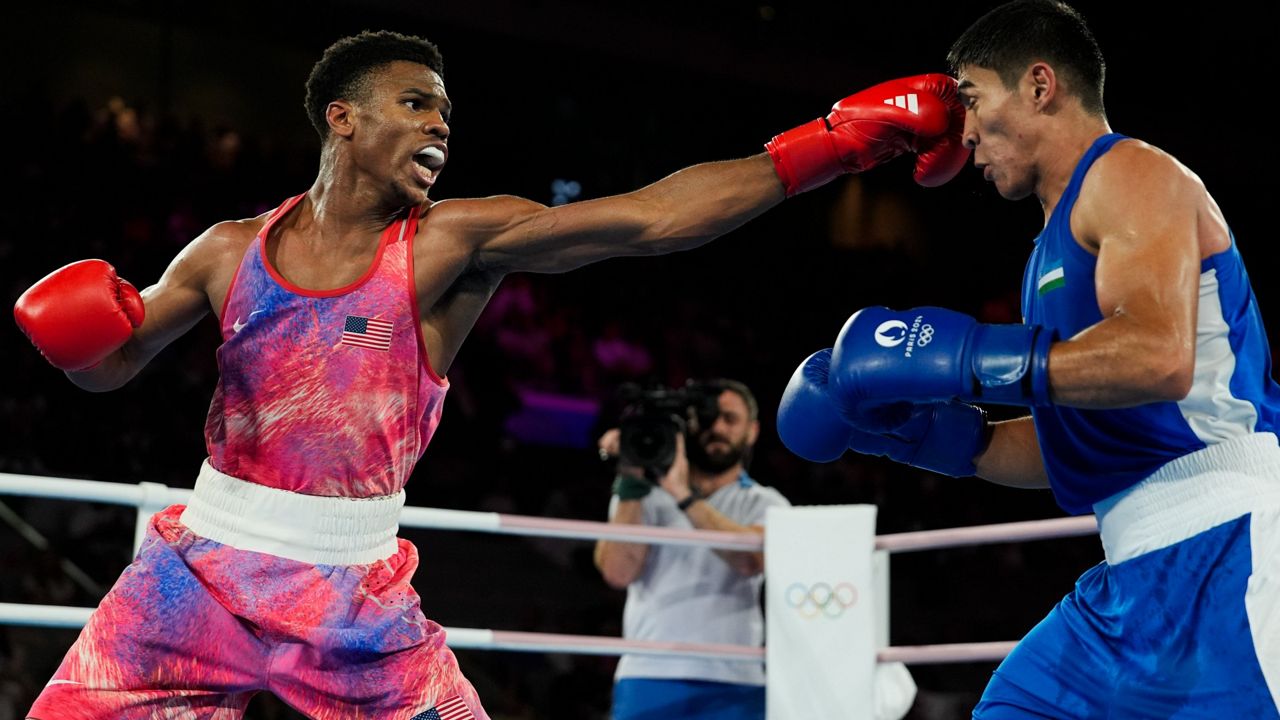
In the boxing arena this evening, history was made. Omari Jones became the first NYAC member ever to win an Olympic boxing medal. Jones had already written his name in the Club’s annals by becoming the first member ever to compete in the sport of boxing in an Olympic Games. To augment that distinction by adding a medal to his name, bronze in this instance, is something of which he, and the Club, should be enormously proud. The NYAC is proud, for sure. Jones, however, was equivocal about his semi-final loss today to Asadkhuja Muydinkhujaev from Uzbekistan.
“It was a great fight,” he reflected. “They gave him the points. It’s whatever the judges saw. I’ll take my bronze and it’s on to the next chapter. My performance was fine. The cards just didn’t reflect in my favor. I didn’t feel any pressure. Boxing is what I do. I came here for something better, which was the gold medal, but that’s what God wanted me to come away with. It’s a lesson and I move on. Let’s see what that lesson is.”
From the outset, it was evident that this was a different bout from the quarter final that Jones dominated. This time, against another southpaw, Jones was more guarded, though both fighters unleashed plentiful vicious blows to the head and body. Four of the five judges gave the first round to Muydinkhujaev (which I’m guessing is pronounced Mwew-DINK-HOO-jeye-ev). In round two, Jones was more animated, moving to the center of the ring and trying to land point-scoring punches that would swing the balance in his favor. But Muydinkhujaev was like a cobra, moving left and right before striking and retreating with lightning speed. It was hypnotizing. At the end of round two, the judges still gave the edge to the Uzbek, though less definitively. The writing may have been starting to appear on the wall, but it was not yet indelible.
In round three, Jones found his stride in a way that he had not in the previous two. However, in trying to find a way to deliver a decisive blow, he had difficulty in landing scoring punches. But, his aggression was evident, to the point that many thought that he had won that round and, possibly, the bout. The judges thought differently, though by a split decision, sending Muydinkhujaev into the gold medal round and Jones home with a still magnificent bronze medal.
To be borne in mind is that Muydinkhujaev is the reigning amateur welterweight world champion. To be beaten by him is tantamount to receiving a physics lesson from Steven Hawking; it may be difficult, but it’s a platform from which to move to the next level. Contemplating what that next level may be, Jones was again philosophical: “I’ll just reflect on my bronze, and take my time and move on to whatever God has next for me.”