
One Day, One Club, Five Olympic Medals (Plus One TBD)
Let’s get straight to the facts. We can add the details afterwards.
This morning at the rowing venue, NYAC member, Chris Carlson, won a bronze medal as a member of the US men’s eight crew.
Soon after that, boxer Omari Jones won his quarter final, advancing to the semis and guaranteeing himself at least a bronze medal. (That’s the TBD reference in the header).
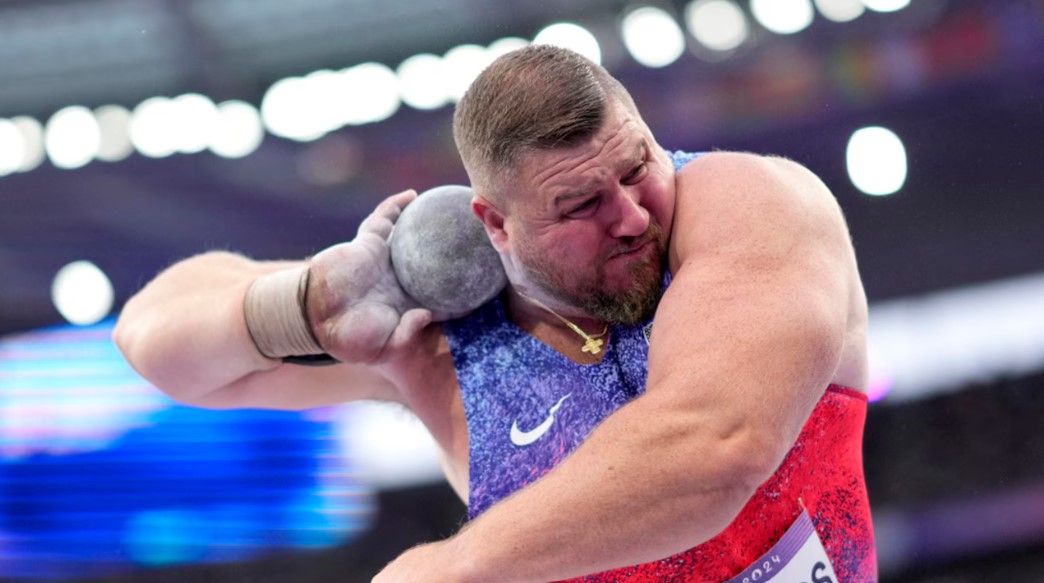
Shot putter Joe Kovacs unleashed a stunning last round throw to take the silver medal in the track and field stadium.
In the swimming arena, Kate Douglass added to her trove by claiming a silver medal in the 200m individual medley.
Also in the water, Paige Madden won a brilliant bronze medal in the 800m freestyle.
And Nic Fink contributed a stellar leg to the world-record-setting, gold-medal-winning US team in the mixed 4x100m medley relay.
Those are the facts. Here’s one more: it was an amazing and historic day. Read on, for details and insights, plus the odd divergence.
At the rowing venue, today was the last day of competition, meaning that this was the day to resolve all the unanswered questions – such as the men’s and women’s eights. In rowing, the eights are like the 100m in track and field. Everybody sits up and takes notice when it comes around. It may not be your distance, but you will watch it! In the women’s event in Paris, six of the eight women in the boat (there are actually nine, but the poor cox gets left out) were NYAC members, including two-time gold medalist, Meghan Musnicki, here competing in her fourth Olympic Games. She, plus all of the other Club members on board – Charlotte Buck, Olivia Coffey, Claire Collins, Regina Salmons and Maddie Wanamaker – had competed in Tokyo, meaning that this was a crew with some considerable experience.
Even so, we always knew that this was going to be tough one, with Great Britain, Australia, Romania and Canada also on the starting line. From the outset, it was the Canadian and Romanian boats that were the most aggressive, Canada holding a marginal lead at 500m, but with Romania pressing hard. As those two powerhouses battled all the way to the line – Romania prevailing by a little over four seconds – the US engaged in its own private war with Australia. Through the half way mark in 2:58.32, the US held an advantage of over a second and a half on the Aussies (3:00.86). Even through 1500, the Americans held the upper hand, 4:30.30 to 4:32.84; but, then the tide began to turn.
Increasing their tempo as the US momentum faltered, the Australians edged in front, crossing the finish line exactly one second up, 6:00.73 to 6:01.73, in fourth and fifth positions, respectively.
“It was a dogfight all the way down the course,” commented Musnicki. “The women’s eight field is deep and formidable, and we went into it after our rep with concrete things that we wanted to work on and execute. I think we did those things and fought the entire way. The nature of sport is that you don’t always win; that’s the harsh reality of it. We ended up on the back side of it today, but I’m really proud of what this boat put together and the campaign that we did. We stayed together, all nine of us, through it all. It’s obviously very disappointing; but, again, that’s the nature of elite sports.”
Fifth in the Olympic Games is awesome. Third is better. Just ask Chris Carlson. He was in the boat that contested the men’s eight final immediately after the women had completed their event. That crew moved into the bronze-medal position as the field approached the 500m mark, just off the pace being set by Great Britain and the Netherlands. The Dutch crew was able to inch ahead in the second quarter of the race, but the British boat regained the lead in the third 500m. With it all coming down to the wire, the British boat consolidated its lead while the US worked hard to cut into the Dutch boat’s advantage. They pulled back a full second, but it was to no avail. Great Britain stormed home in 5:22.88, with the Netherlands taking silver (5:23.92), and the USA a superb bronze (5:25.28). For the Americans, this was the first medal in this event since 2008, when the crew also won bronze. It was the 17th time in Olympic history that the US has won a medal in the men’s eight.
In other news, today an entirely new page was written in the (voluminous) book of NYAC athletic achievement; specifically, Omari Jones became the first ever Club member to win a medal in Olympic boxing. (Notably, Jones is also the first NYAC member ever to have competed in Olympic boxing). Peculiarly, as of today, we don’t know what color of medal Jones will receive.
I will explain. This afternoon, Jones fought in the quarterfinals of the 71kg division, his opponent being Rami Mofid Kiwan, a rangy southpaw from Bulgaria. From the outset, the NYAC man had the upper hand, controlling the pace with a series of jabs and powerful rights to the body that kept Kiwan off-balance and on the back foot. When he did come forward, Jones was always able to find the vulnerabilities, allowing him to unleash his withering combinations.
The five Olympic judges unanimously decided all three rounds in Jones’ favor, meaning that he advances to the semi-final, where he will face Asadkhuja Muydinkhujaev from Uzbekistan. That match is scheduled for next Tuesday (August 6th). Overlooking the challenges that the commentators will face, the loser of that bout – along with the loser of the other semi – will receive a bronze medal. Our hope, of course, is that Jones will battle his way into the final; he certainly looked like an Olympic gold medalist today; but even if that is not to be, Jones, and the NYAC, must find enormous gratification in the fact that, today, both of them earned their first Olympic medals in boxing.
Coming into these Games, Joe Kovacs already had two Olympic medals, both silver. This evening, he embarked on a quest for one more. As noted yesterday, Kovacs has contested every major championship since 2015 and never failed to win a medal. Truth be told, in yesterday’s qualifying round, he did not appear as confident as he has in other championships, taking all three of his allotted throws in order to advance to the final, rather than launching a single automatic qualifier as had, say, Ryan Crouser, the world record holder, two-time Olympic champion and, by many, estimates, the greatest shot putter of all time. That is not to say that a Crouser victory is a foregone conclusion; even he would not say that. Presumably. I don’t know him; maybe he would. And Kovacs has beaten him on more than one occasion. However, the latter does need to be at the peak of his form if he is to challenge the favorite, not to mention turn back formidable putters like Leonardo Fabbri from Italy, the Kiwi pair of Tom Walsh and Jacko Gill, plus the third American in the field, Payton Otterdahl. (Famously, Crouser recently stated that, if the whole world had to compete in the US Olympic Trials, only Americans would make the team). (Thinking on it more, maybe Crouser did feel that the result is a foregone conclusion).
Once the competition started, it was as if Kovacs wanted to reassure everybody that all was well. Throwing fourth, he unleashed a 21.69m/71-2 heave that moved him to the forefront of the field. Crouser was throwing sixth. He stepped into the circle and, basically, tried to answer all questions right from the outset, settle the medal order, prove that, yes, forget modesty, this is a foregone conclusion. When it eventually came down to land, Crouser’s mark was 22.64m/74-3½, the best part of a meter ahead of Kovacs and the rest of the field. Fabbri, Walsh and Gill all fouled their first attempts, leaving Crouser and Kovacs at the head of the field at the end of the first round, with fellow American Payton Otterdahl in third (21.39m/70-2½).
In round two, Otterdahl solidified the Americans’ hold in this competition, launching a big one of his own, 21.98m/72-1½ to be precise, and moving into second, behind Crouser and ahead of Kovacs, who fouled his second. Crouser’s second round throw did nothing to change the order, only increase his lead by 5cm, to 22.69m/74-5½.
But there were still fireworks to come. On his second attempt, Jamaica’s Rajindra Campbell felt the fire and sent one into space. It landed 22.15m/72-8 later, setting the order at Crouser, Campbell, Otterdahl and Kovacs. Otterdahl’s third attempt reached 22.01m/72-2½, a 3cm improvement, consolidating his third-place position. Kovacs improved by two cms to 21.71m/71-2¾; but still he remained in the worst of all positions: fourth.
Crouser just kept getting better. On his third try, he reached a mark – a 22.90m/75-1¾ season’s best – that told everybody else in the field that, by all means, they may dream of silver and bronze, but this gold is already decided. Halfway through this competition, it was Crouser with a dominant lead, Campbell in second, Otterdahl third and Kovacs fourth. That said, there was still everything to play for. Kind of. Not really everything. Two-thirds of everything.
Kovacs’ fourth was a foul as was Crouser’s, the latter only because he didn’t like it, so walked out of the front of the circle. Intentional foul. No need to measure that one. In the fifth round, Kovacs fouled again, meaning that everything rode on his sixth and final attempt, the throw that would determine if his nine-year streak of championship medals would continue or come to an end. The NYAC man was not alone in fouling in the fifth; so did all of the leading six.
Well, there are clutch performers and there is Joe Kovacs. With everything on the line, and seemingly out of the hunt, he stepped into the circle and showed that he is never to be counted out until he is actually out. He showed, in fact, why he is Joe Kovacs. Attacking the circle with a purpose he had not showed in five previous attempts, he sky-rocketed the ball off his shoulder and out to a massive 22.15m/72-8, a mark not challenging Crouser but seeing him leap into the silver medal position, and take his third consecutive Olympic silver while illustrating that he is, without question, in the pantheon of the greats. Crouser, in fairness, was a class apart; but, there is no denying that when the Guinness Book of Greatest All-Time Shot Putters is published, Kovacs will be on page one.
“It was pretty tough,” commented the new Olympic silver medalist. “I was swinging for the fences, going for the gold. I didn’t want to leave here without a piece of hardware. Of course I wanted the gold, but I’m really proud of how I did that last throw. I had to go to a pretty deep place to find that. It’s that focus that I’m proud of. This is my third Olympics and I think this is the first one where I feel like I really experienced it. I take in this moment. I don’t know if I have another one in me. I hope I do, but at the same time I’m proud that I went out there. My wife is my coach and all the hard times we went through to put that together, it’s all that pride. It all has to be for something. I’m glad, when I put that ball on my neck, that I didn’t get soft. I went after it. Coming home with another silver, I’m pretty proud of that.”
The day was far from over with Kovacs’ stunning performance. In some ways, it was only beginning, late though it was getting. In the swimming venue, the NYAC’s competitors were on fire, with three – Kate Douglass, Paige Madden and Nic Fink – all claiming medals.
Douglass, already the owner of two medals from these Games, this evening contested the 200m individual medley, employing her trademark late-race surge to edge past compatriot Alex Walsh just inches from the line and claim the silver medal. Walsh, indeed, had been leading into the final 50m, the freestyle leg. But that was when Canada’s 17-year-old phenomenon, Summer McIntosh, moved into a higher gear, gaining ground that seemed to have been forsaken and powering into the gold medal position. Douglass, too, swam a storming final leg, claiming precious inches and overtaking Walsh in the final 15 meters to take a superb silver. For Walsh, there was no solace at all; having gone from gold to bronze in the closing meters of the race, she was then disqualified for an illegal turn maneuver.
There was no such controversy in Paige Madden’s 800m freestyle; her race was characterized solely by a tactical astuteness that saw her close with remarkable power over the final 100m and surge into the bronze medal position behind Katie Ledecky – her fourth consecutive in this event – and Australia’s Ariarne Titmus.
“I just wanted to give it everything that I had,” asserted Madden. “And, I knew that I had a lot to give, based on my training. I knew I had it in me and I just wanted to lay it all on the line.”
Madden certainly did that, dropping her best time by approximately five seconds in the process of claiming her place on the podium.
A third NYAC medal in the pool came courtesy of Nic Fink, who swam a momentous second leg in the mixed 4x100m medley relay. Fink took the breaststroke leg, going head to head with China every stroke of the way. So it was for the team through the entire race, with France and Australia hanging close and trying to make gains on the leaders. As the race progressed, however, it was evident that it was either the US or China claiming the gold medals. Torri Huske (non-NYAC) made everything clear in the closing 50m, opening daylight on Junxuan Yang and reaching the wall with 0.12 seconds to spare. Icing on the cake were the world record figures of 3:37.43 that took 0.15 seconds off the old standard set by Great Britain at the Olympic Games in Tokyo in 2021.
Wrapping up the news from the pool, Hunter Armstrong, Nic Fink and Kate Douglass have the opportunity for still more medals in tomorrow’s final day of Olympic swimming, the US team having advanced comfortably to the finals of the men’s and women’s 4x100m medley relays. The relays are always riveting. Don’t forget to watch.
The men’s water polo competition is approaching the seriously interesting phase. Group play is still underway, the men today facing Montenegro, a competition that they had to win in order to advance to the knock out stage. It wasn’t easy, but the team got the job done, leading throughout and ending the bout with a score of 12-7. The NYAC’s Hannes Daube may rightly claim to have been the MVP, having found the net five times from seven shots on goal. He is ranked third in scoring in the tournament with 12 goals in total. Max Irving also logged two in this match and Alex Obert one. The US has one more match in group play, Croatia on Monday (August 5th); but, their place in the next round is secured. That said, advancing as fourth in their group means that they will face a top seeded team in the quarter-finals. Uh-oh.
Today I saw something that I have never seen in all my years of covering major international sporting events. The competition in question was the pole vault in the decathlon, the eighth event that these athletes had faced in the course of the two day competition. Progressively, all had fallen to the wayside – including the NYAC’s Harrison Williams; although he had enjoyed a spectacular vault series – and now there was just one man left standing, Janek Õiglane from Estonia, who had galvanized the crowd as he inched the bar ever upward, making it look oh so smooth as so many others faltered.
Now it was just him at the end of the runway, the bar at 5.30m/17-4½, and he steadying himself to go. And you could hear yourself breathe. None of the 30,000 or so people in the stadium uttered so much as a sound. (This was the morning session; some had left). Yes, we’ve heard the sound of silence before, at the start of the sprints, particularly. But once the gun goes in those events, the crowd erupts. And, in the field events, a raucous rhythmic clapping accompanies the athlete down the runway. Not this time
Õiglane gathered himself and took off like rocket…and there was not a sound, just the slapping of his feet and the pumping of his breath. You could hear it in the cavernous silence. It was eerie. And then he cleared the height and the place went insane. The contrast was startling and spectacular. Õiglane is a world class decathlete, but I had never heard of him. Now I’ll never forget him. You never know where your enduring memories will come from.
I would be remiss when writing of the decathlon if I did not speak more of the aforementioned Harrison Williams. He had been having a monster competition, ending yesterday – day one in this two day event – in eighth position, just 218 points down on the leader, and continuing today, pushing forward, hopefully towards the medal positions. A 14.28 second 110m hurdles and a 46.91m/153-11 discus throw moved him into fifth; then, he produced a spectacular pole vault series that saw him reach 5.10m/16-8¾, the third best of the day. That brought his points tally to 7118, keeping him in fifth, but just 292 points behind the leader, Leo Neugebauer from Germany, and a mere 73 points shy of a medal position. By way of context, for his pole vault mark, Williams earned 941 points; 73 is an eyelash.
The two remaining events in the decathlon were the javelin and the 1500m. The first of those was where the bump came in the road. Williams could not match the standard of his pole vault, reaching a best mark of 51.17m/167-10 which brought him just 606 points, basically erasing his medal chances. At this level, and at this stage of the competition, somewhere north of 850 would be what he wanted; but, with the man-killing 1500m to come and Harrison in ninth position on 7724 points, he faced a mammoth task. His 4:19.58 1500m did pick up a robust 814 points and did move him up to seventh overall, still a commendable result; but, it is tantalizing to think of what might have been. Had he been able to score the same number of points in the javelin that he did in the 1500m, Williams would have been on the podium. So it goes.
Here, another brief diversion. Steve Ovett, legendary miler and 1980 800m Olympic champion, once called the decathlon “Nine Mickey Mouse events and a 1500m.” That’s harsh; but, you’ve got to admit it’s pretty funny. All the more so as he said it to his compatriot, Olympic decathlon champion Daley Thompson.
There was so much NYAC action going on today that I make no secret of the fact that it was difficult to keep track of it all. Much of the action resulted in dramatic surprises as detailed above, most of it good, some of it less good; which is the way it’s supposed to be, when you think about it. Chris Nilsen, the Tokyo 2020 silver medalist in the pole vault, would probably agree that he falls into the less good category. In a surprising and disappointing turn of events, he went out in this morning’s qualifying rounds, only managing to clear 5.40m/17-8½, a height well below his best of 6.05m/19-10¼. Nilsen would have been justified in having medal expectations coming into this meet. Now, for reasons still to be explored, he finds himself in the worst of all positions for an elite athlete, indeed for any athlete: that of not having fulfilled his potential. It is, to paraphrase W.B. Yeats, the terrible beauty of Olympic competition.