
The Olympics: Amazing and Brutal
If an action-packed morning is your ideal way to get your day going, then today was your kind of day, especially if you are an NYAC member, or simply a fan of the NYAC. That said, if you had thoughts of actually getting to all of the venues where the Club’s athletes were competing in order to cheer them on, you would have needed a helicopter or, better yet, that transponder machine from Star Trek.
To cover all of the bases, you would first have had to get to the triathlon venue, located in the very heart of Paris, at around 8am. It would have been totally worth it to see the US men (Seth Rider and Morgan Pearson) and women (Kirsten Kasper, Taylor Knibb and Taylor Spivey) – all NYAC members – in action. The women were up first, the men going next, having been re-scheduled from yesterday. Those races take the best part of two hours each. By which time, Kate Douglass’ heat of the 200m breaststroke at the La Défense Arena in north-west Paris was long over; that started at 11am. But, if you had managed to travel through time and space to get there (the Tardis would have worked better than the transponder, on reflection), you would then have had to transport yourself, by whatever means, all the way to the Vaires-sur-Marne Nautical Stadium 90 minutes away on totally the other side of the city – actually way beyond the city. There, at 11:34am, you would have caught Molly Reckford in the semis of the women’s lightweight double sculls. And, of course, you would have had to hang around for the B final of the women’s quad sculls, with Teal Cohen in the boat. But then you would have missed Omari Jones’ opening bout in the boxing arena back at Roland-Garros Stadium all the way back in the city. That was at 11:48am. Then, somehow, you’d have to get back to the Grand Palais, close to where you had started many hours and many miles previously, in order to catch the 1:30pm appearance of Mitchell Saron (USA) in the men’s sabre team event. And, if you did catch that, you would have had to hustle out of there to get to the Aquatics Center to catch the US women versus Italy in the water polo prelims at 6:30pm.
That’s what you call a morning (and afternoon). Good job you’ve got a couple of hours respite because you need to be out at the swimming venue again at 10:03pm to catch Kate Douglass in the 200m breaststroke semis. To handle all that, you would need to be in shape to compete in at least one of those events. So that’s not happening. But NYAC action was happening, all day long; and here it was.
Starting with the triathlon, the women were the first to go, with the NYAC’s powerful trio of Taylor Knibb, Taylor Spivey and Kirsten Kasper all carrying high hopes. Knibb, in particular, wished to erase the memory of her ill-fated outing in the cycling time trial on Saturday (July 27th) when the rain-slicked roads caused her to crash three times. This outing wasn’t much kinder, sad to say. A problematic swim saw her leave the water in 33rd place, more than two minutes down on the leader, Bermuda’s defending champion, Flora Duffy. Knibb fought bravely around the bike segment, narrowing the gap to just over one minute; but, she was never able to get any closer, in fact losing considerable ground on the run and finishing 19th, ironically her same placing as in the cycling event.
Kasper also had a problematic day, despite looking powerful in the early going. In ninth place after the 1500m swim in the Seine, the slick conditions proved problematic and, while working hard in the second pack on the bike leg, she crashed, then got a flat tire, then crashed two more times, ultimately riding on the rim just to get to the wheel swap zone. An Olympic nightmare. At the transition, she was 51st, a placing she improved to 49th by the finish of the run, far from where she had hoped to be.
Taylor Spivey was the one with cause for satisfaction, though she, too, may be a shade disappointed to go home with no hardware. Twelfth leaving the water, she ensconced herself in the lead pack throughout the cycling stage, holding fourth as the pack approached the second transition. Also in that group were France’s Cassandre Beaugrand, Julie Derron from Switzerland, Emma Lombardi from France, Beth Potter from Great Britain and the aforementioned defending champ, Duffy from Bermuda, plus a handful of others, three or four seconds covering the entire pack.
It was the run segment that told all the tales, therefore. While Derron was the aggressor through the early going, paring the leaders to herself, Beaugrand, Lombardi and Potter, there was no denying Beaugrand when she decided that it was time to go in the final two kilometers. Injecting a ferocious surge, the Frenchwoman sped to the finish line – to raucous cheers – ahead of Derron and Potter, while Spivey worked hard in the burgeoning humidity, ultimately placing 10th, 2:16 down on the winner.
The team, assuredly, hoped for more; but, c’est la vie, as they say in France. Which is essentially what Knibb said: “I’m severely disappointed, but you keep moving on with life.”
The men were next up, both US representatives, like their female counterparts, being members of the NYAC, Seth Rider and Morgan Pearson by name. It had been Rider who, at the USA Triathlon press conference earlier in the week, said that he increased his tolerance to e-coli by progressively exposing himself to it on a daily basis, doing things like “not washing my hands after I go to the bathroom.” He was kidding. I’m pretty sure. Yes, definitely kidding. In any event, neither man had their best day in Paris, though both fought tenaciously as the heat and humidity increased.
While Great Britain’s Alex Yee pulled off a startling come from behind victory, the two NYAC men faced their respective challenges along the route. Pearson was 34th coming out of the water, already 1:20 down on the leaders; but Rider enjoyed a powerful leg, emerging eighth, 20 seconds down. The latter stormed through the ride, finishing in ninth place, just a single second down; meaning that with the 8.55K run ahead of him, he could rightly entertain hopes of being in the finish line mix. It was not to be, sad to say. As Yee brutalized the field, Rider struggled, losing over four minutes and ultimately placing 29th.
Pearson’s was also a tough day in the office. Having struggled through the swim, he lost more time on the bike, reaching the transition in 40th place, though managing to get himself back to 31st by the conclusion of the run.
In truth, and without being harsh, none of the Club’s triathletes were where they wanted to be and should have been. That is because they are all among the world’s best, with expectations at that level. But in the words of Taylor Knibb, “The Olympics are a huge endeavor. They’re tough; both amazing and brutal.” Sometimes, more one than the other.
From triathlon, it was over to rowing and Molly Reckford in the semi-finals of the women’s lightweight double sculls, plus Teal Cohen in the B final of the women’s quad sculls. In Reckford’s race, she was back in tandem with her long-term boatmate, Michelle Sechser. Contesting the first semifinal, they got off the line even with Canada in third position, trailing Great Britain, the two-time world champions, and New Zealand. The two lead crews battled through the 1000-meter mark before the British boat began to edge ahead. As they forged on to victory ahead of the Kiwis, Reckford and Sechser also placed daylight between themselves and Canada, crossing the line in third place and securing their position in the A final, scheduled for Friday (August 2nd). Sechser and Reckford finished fifth in Tokyo; the USA last won a medal in this event in 2000. Commentator, the legendary Sir Steven Redgrave (rowing gold medals in five consecutive Olympics; no wonder he’s a “Sir”) called the US performance, “The row of the day.” I’m just saying. More accurately, Sir Steve is just saying.
“We went into the race with the right attitude today,” stated Reckford. “ I said to Michelle, ‘Live or die, we’re fighting for the line.’ It was a dogfight out there. This is the sort of race where people go crazy and pull out moves that you’ve never seen before. But we stayed calm and trusted each other.”
In the quad sculls, Cohen and her three partners finished third in the B final, giving them ninth place overall. Australia led from the start, with the US and Romania sitting just off the pace. Romania edged ahead at the halfway point, increasing their lead in the second half as the US boat inched ahead of Australia. It was a margin they could not maintain, however, as the Aussies surged back ahead in the closing stages, making the final order Romania, Australia, USA.
From rowing, we turn to boxing and Omari Jones, the first NYAC athlete ever to appear at the Olympic Games in this sport. Competing in the 71kg division, Jones opened his Games in the round of 16 against Kan Chia Wei of Chinese Taipei. It went the full three rounds, as it often does in amateur bouts, but all three were adjudged to belong to the NYAC man, and he won by unanimous decision of all five judges. That’s not to say that it wasn’t a bruiser; more accurately, it was hard-fought, but with Jones in the driving seat all the way. He now advances to the quarter-finals, set for Saturday (August 3rd) at 4:02pm Paris/10:02am EST. There he will face Bulgaria’s Rami Mofid Kiwan.
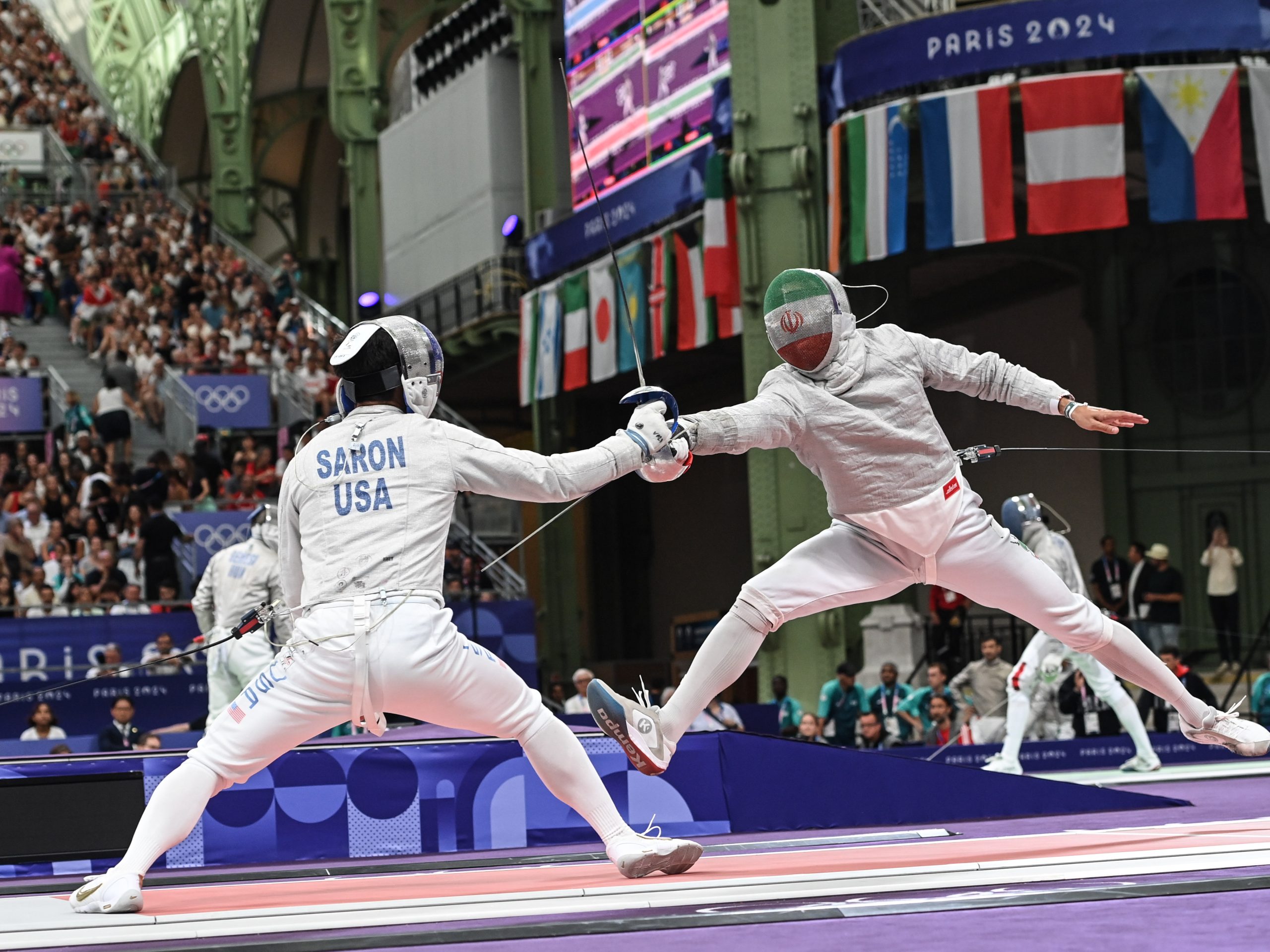
Then we had fencing and the men’s team saber competition with Mitchell Saron competing for Team USA. Members may recall the Celebrating Fencing evening at the City House a few weeks ago, at which Saron appeared, along with Kat Holmes, Anne Cebula and modern pentathlete Jess Davis. From the City House to the Olympic Games seems like both a lengthy journey and a natural progression.
In their first bout, the USA had narrowly lost a battle with Iran (44-45). Next up was was Italy and a second loss, this one 40-45, leaving the US to face Canada to decide places seven and eight.
The US held the upper hand throughout the competition, but in the very last round Canada made a powerful come-back that reduced a four point deficit to two, but which still left the US as a 45-43 point winner.
In the aquatics center, the US women’s water polo team was back in action, eager to avenge the upset defeat that they had suffered at the hands of Spain on Monday. This time, they allowed no room for error, romping to a 10-3 victory over Italy that moved them into second in their group behind Spain. The US was never behind in the game, leading 3-1 and 6-2 at the end of the first and second periods. It was in the third period that they truly pressed home, holding Italy scoreless, while putting two more marks on the board. In the fourth, Italy added one, but the USA (read, the NYAC) added two, leaving the final score at 10-3 and restoring a substantial degree of the team’s confidence.
In this morning’s heats of the women’s 200m breaststroke, the NYAC’s Kate Douglass, already a silver medalist at these Games, did precisely what she had to do to advance to this evening’s final; namely, win her heat with a powerful closing 50m, illustrating that she is ready to challenge for hardware. Before she could do that, though, she had to progress through this evening’s semi-finals, no easy task given the names also lining up: Tatjana Smith (RSA, already winner of the 100m breaststroke) and Mona McSharry (IRL, bronze in the 100m breaststroke) being just two, and both in the NYAC woman’s semi. It was almost a final within a semi-final.
Hopefully, that is the case in the final proper, because the NYAC woman swam it like medals were on the line, employing her signature late-race strength to edge into the lead in the final 50m and touch the wall a clear winner over South Africa’s Smith. Douglass’ winning time was 2:19.74. In winning the other semi, Tes Schouten from the Netherlands clocked 2:22.74. I’m not saying anything (again); I’m just saying.
Tomorrow, we’ve got rowing, water polo and swimming. That almost seems like a day off. But it’s far from that; four of those are finals! In rowing, we’ve got the women’s four (Kelsey Reelick) and men’s four (Nick Mead), and in swimming the women’s 200m breaststroke (Kate Douglass) and the women’s 4x200m freestyle relay (Paige Madden, though the team must first contest the morning’s heats). We have every cause to be optimistic, but while bearing in mind that these are the Olympic Games; they’re amazing and they’re brutal.