
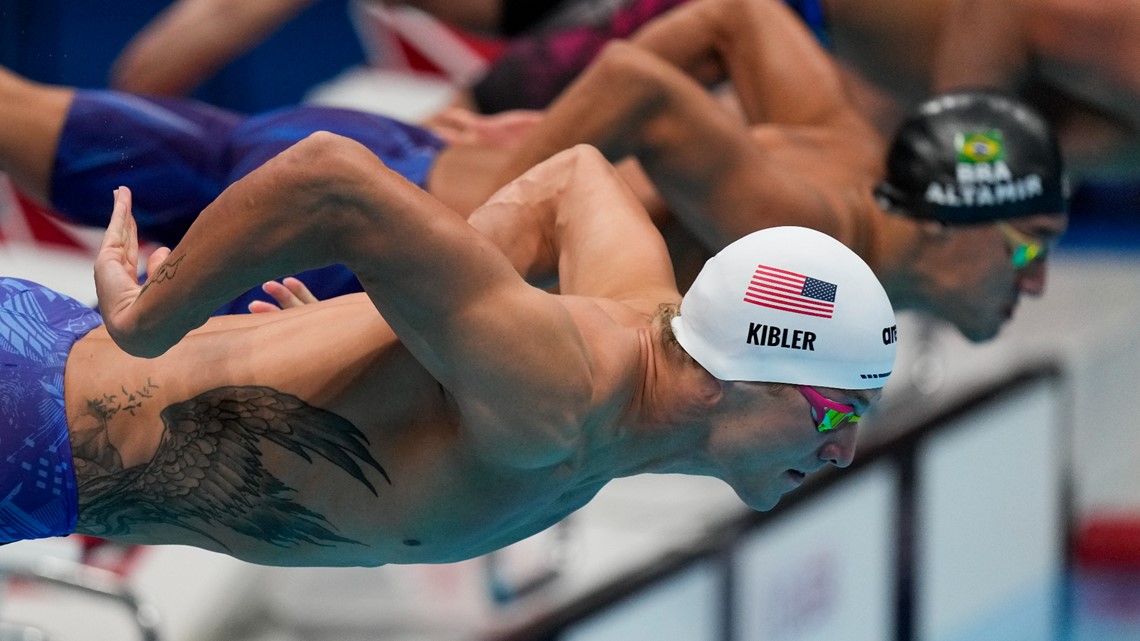
Kibler Takes Silver. NYAC Medal Tally Now at Five
This evening, in the Olympic swimming pool, Drew Kibler wrote the latest page in the NYAC’s illustrious athletic history. As a member of the US squad that cruised through this morning’s heats of the 4x200m relay (first in heat one with a time second only to Great Britain, winners of the second heat), Kibler and teammates – Kieran Smith, Luke Hobson and Carson Foster – rightly approached this evening’s final with expectations of a medal, even gold. The US does have a powerful pedigree in this event, after all, being both the world and Olympic record holders. The only problem was those pesky Brits, whose form was intimidating, if not spectacular – as evidenced in the heats – and who came into this race as defending champions determined to retain that crown. Not to be forgotten were the other powerhouse teams, particularly Australia and Germany, both of whom were poised to pull an upset should any of the favored nations falter.
With a 10:15pm (Paris) kick-off, this race was the last on the evening’s program; but the stadium was still jammed to the rafters, all of which shook to the shouts of “USA! USA!” and whatever British people say that’s comparable. Probably, “Have a nice swim, there, chaps.” In any event, the Brits were fired up, the USA was ready to go, and nothing was pre-determined.
James Guy, the British opener, took off like it was, scorching through the opening leg and reaching the exchange almost half a second up on Germany, with the USA’s Luke Hobson a hair’s breadth behind. The second leg saw the British team retain its lead, though by no means with a sufficient margin to go on cruise control. The US – Carson Foster – was in second and chasing hard, with Australia and Germany applying pressure and keeping everybody honest.
When he learned that he was going to swim in the final – the third leg – the NYAC’s Drew Kibler texted his teammates saying, “I’m going to give it everything I have.” That was evident from the moment that he left the blocks. Kibler unleashed a third leg of Olympian standards, charging hard for the leaders and placing precious inches between himself and the Australian team, the German’s progressively fading from view. From that point on – conceding that it’s not over until it’s over – a medal of some color seemed assured.
In reality, there was no catching the magnificent Brits as cheers of “Jolly good show” resounded throughout the venue. And the USA’s anchor, Kieran Smith, was clearly never going to let himself be caught; so, that’s how it stayed, all the way to the wall. Great Britain the victors, Kibler and the USA superb in silver, and bronze for Australia.
“It wasn’t lost on me, the significance of this race,” commented Kibler, referring to the team’s fourth place finish at the Tokyo Olympic Games. “The standard remains that we want gold; but, I’m proud of this effort, and I’m proud to get back on the podium for the USA. It’s a special moment.”
Not solely, for Drew Kibler; for all of the NYAC members, unknown to him, who follow him and who support him and who, like him, are proud.
Outside of the pool, upon rising this morning, there was good news and there was bad news. What would you like to hear first? OK, the bad news. The men’s triathlon, scheduled for an 8am start in the Seine has been postponed until tomorrow (Wednesday, July 31st). The reason? As you may imagine, “Water quality levels that did not provide sufficient guarantees to allow the event to be held.” The official statement continued, “Unfortunately, meteorological events beyond our control [Aren’t they always?], such as the rain which fell over Paris on 26 and 27 July, can alter water quality and compel us to re-schedule the event for health reasons. Despite the improvement of water quality levels over the last hours, the readings at some points of the swim course are still above acceptable limits.”
This issue, of course, has stimulated enormous debate over the past several months and begs one significant question: as this circumstance was always a distinct possibility, why was the decision to hold this event in the Seine not overturned long ago and a more stable swimming environment secured? No one could deny the spectacle of holding the Olympic triathlon in the French capital’s celebrated waterway; but, that could have been weighed against the eventuality of not being able to hold the event at all. At one stage, organizers postulated that, if necessary, the swimming segment would be eliminated from the competition, a decision comparable with changing the decathlon to a nine-tathlon or changing the marathon to a 20 miler and altering the character of the event, and its outcome, entirely. As it stands, we are left with the least worst option, the men’s tri having been re-scheduled for tomorrow morning, after the women’s race. If conditions still predicate against holding those races, August 2nd is being slated as a contingency. If that doesn’t work…well, we will swim under that bridge when we come to it (e-coli permitting. Let’s not forget that the marathon swim is scheduled for August 8th and 9th, in the Seine.
So much for the bad news. Other water-related news is actually very good. In Sunday’s heats of the women’s four, the US team, featuring the NYAC’s Kelsey Reelick, had placed fourth – edged out by China and beating only Denmark – a placing that sent them to this morning’s repechage. This time around, the US foursome was far more purposeful, starting cautiously in third place through the opening 500m, but moving to second at 1500m and then powering past the leading Chinese boat with the finish line in sight to claim their spot in the A final on Thursday (August 1st). In that race they will face China, Great Britain, the Netherlands, Romania and New Zealand, the world record holders. That’s what you call a loaded field.
From the water, NYAC interest turned to the Grand Palais, hard by the Champs Elysée and site of the Olympic fencing competition. The individual events have been concluded, so today it was time for the women’s team épée competition featuring the NYAC’s Anne Cebula and Kat Holmes, the latter competing in her third Olympic Games. With non-NYAC members Hadley Husisian and Margherita Guzzi Vincenti also in the squad, the US was chasing its second ever medal in the event, the first, a bronze, having come in London in 2012, when three NYAC members were on the team (Courtney Hurley, Kelley Hurley and Maya Lawrence). It wasn’t going to be easy; with eight teams in the tournament, the US was ranked sixth. Their first round match today was against Poland, ranked #3.
By way of background, the women’s épée team event was only added to the Olympic program in 1996, at the Atlanta Games. Even so, it wasn’t a permanent fixture, being excluded in 2008 as the IOC elected to rotate some events in and out. Thankfully, it’s back, because it’s a thriller. If you don’t know how team competitions work in fencing, here’s a primer (although, it’s actually more complicated than this): teams of three compete in a round robin-type match where each fencer fights every other fencer, meaning nine bouts. The first team to score 45 points, or the team leading when time expires, is the winner. Basically. And if you follow the competition round by round, it can be a nail-biter, as it was today.
It is fair to say that the US was the underdog coming in to this competition, with Poland being a frequent medalist on the world cup circuit. That did not prevent Husisian from going on the offensive from the outset, setting a tone for the competition that endured to the end. Husisian ended her bout 3-1, then handed over to Guzzi, who kept the pace going, ending her round one point up with a cumulative total of 5-4. So, it continued. Anne Cebula was on fire in the third round, maintaining the lead and handing back to Husisian, with the score at 7-6.
Poland drew even in round four, 10-10, but Cebula claimed a superb five touches in round five, which ended 15-12. Poland, as they say, was on the back foot, and the US was driving the bus. Round six ended 18-15; seven was 21-19 and, with two bouts remaining, a startling upset was at hand. But, unfortunately, it ain’t over until it’s over.
In round eight, the tide could be seen to be turning. Husisian did not fully have the measure of Poland’s Renata Knapik-Miazga and, although the round ended 25-24 in the USA’s favor, the danger signs were flashing.
The NYAC’s Kat Holmes subbed in for this last and crucial round, bringing with her a welter of experience beyond all others on the team. Even so, Poland’s Martyna Swatowska-Wenglarczyk managed to find her way through Holmes’ defense, bringing the scores even and then taking a one point lead, the first time in the competition that Poland had edged ahead. Holmes knew the danger and went to war, clawing back a point and attacking hard. But with each attack, Swatowska-Wenglarczyk saw the way through. At the bout’s end, the Pole had scored seven touches to Holmes’ four, leaving the final score at a heartbreaking 29-31 in favor of Poland.
The disappointment was etched on the faces of the US team, stunned to have lost a victory that was oh-so-close. The result put them into the classification round to determine places 5-8; there, deflated, they were beaten by South Korea. That loss sent them into a bout against Egypt to determine seventh and eighth places. With Cebula and Holmes still in the fray, the team prevailed 44-30, leaving them in seventh position, a placing far from illustrative of how they competed and their potential. That’s not much consolation to them for right now, but maybe eventually, or soon.
Next, it was time for more water, this time in the Aquatics Center for the second round of pool play in the men’s competition. In their first match, against Italy last Sunday (July 28th), the US had been beaten 12-8. This time, their adversaries were Romania, a team that was only added to the Olympic program after South Africa withdrew. That being the case, the US may have been confident of securing their first Paris victory. That proved to be the case, but Romania by no means made it easy, being the first to put the ball in the net, which they did after just 45 seconds. At the end of the first quarter, the scoreboard showed 3-3 and it was evident that the US team needed to takes things in hand. The NYAC’s Hannes Daube opened the scoring in the second quarter, and Dodd Ryder (non-NYAC) and Max Irving added two more, leaving the score at 6-3 at the half way mark.
Thereafter, the USA exerted control, adding score after score throughout the third and fourth quarters until, at the final buzzer, the tally stood at 14-8. Hannes Daube and Alex Bowen led the team in scoring, with three goals each. The USA’s 1-1 record means that the team is currently tied with Croatia and Greece in second place in the group standings, although Greece has only played one match, so far. It is they that the US will meet in their next match, which takes place on Thursday (August 1st).
Which brings to the end another day of remarkable NYAC accomplishment. The curious thing is that an athlete who does not win or who is disappointed in their performance often feels that they are somehow less, somehow diminished. In reality, the converse is true, as I have witnessed all day long, and every day at the Olympic Games. The only time that an athlete is diminished is when they choose to give less than their best, when they, in actuality, do not compete. Today, I saw athletes who were disappointed in their performances, I saw athletes who performed well but wanted more, and I saw some who were beaten and delighted. Which is, indeed, the essence and beauty of competition, magnified one thousand-fold at the Olympic Games. That is why the creed of the Olympic Games is so resonant: The important thing in life is not the triumph, but the fight; the essential thing is not to have won, but to have fought well.