
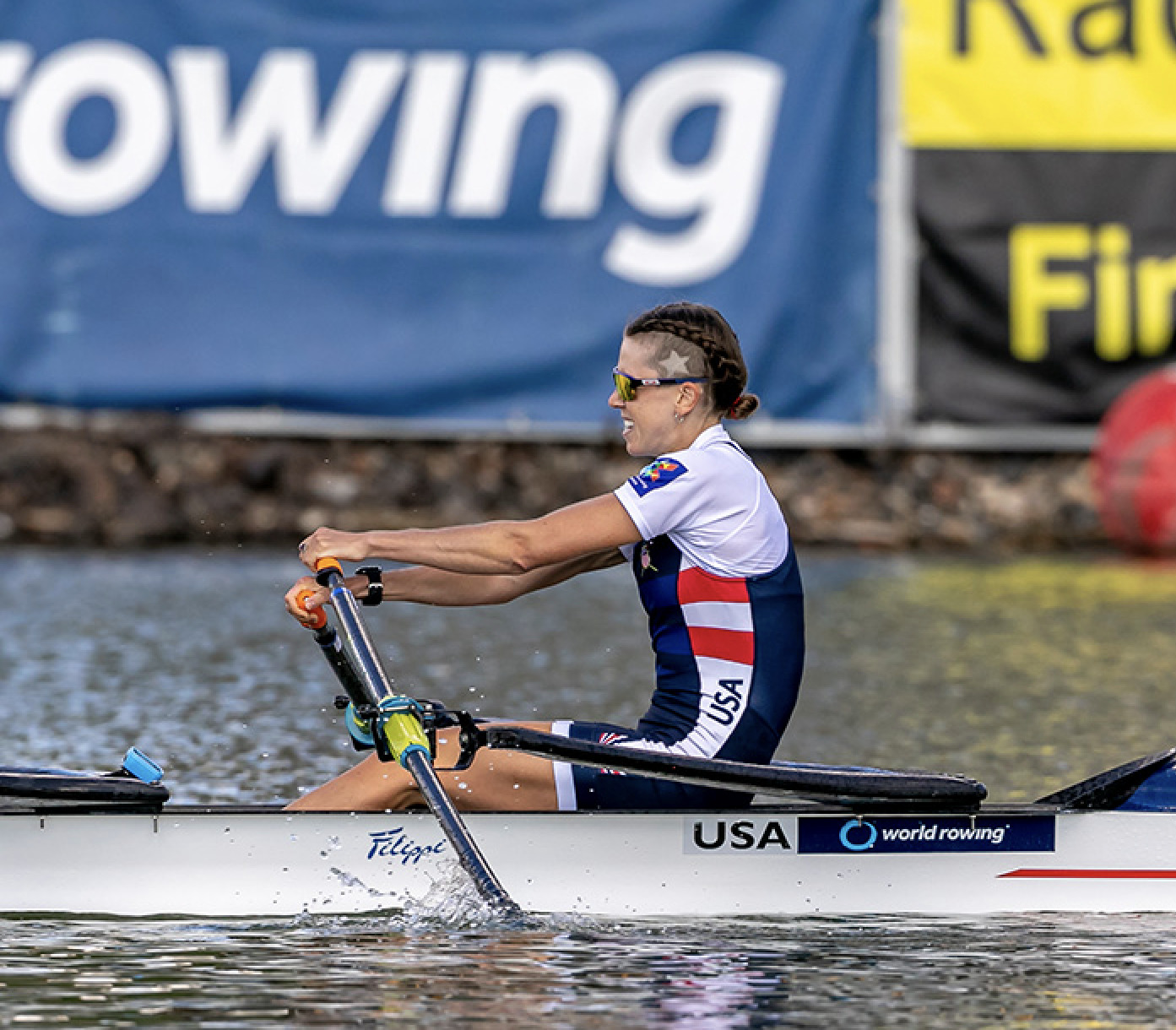
Q&A with Olympic Rower Molly Reckford
As the Olympic Games approach and as NYAC athletes are selected to compete in Paris, we will be speaking with them to gain insight into their journey to the Games, into their preparations and into their aspirations once competition begins in the cauldron of Olympic competition. Here we speak with two-time Olympian, rower Molly Reckford.
How did your pre-qualification training block compare to your current training preceding the Games?
Now that qualification is complete, we are focusing much more on volume and building out a very strong base fitness. We trained a lot of volume and heavy lifting over the winter, but had to bring that down and focus on speed-work heading into selection camp. Now that Olympic selection is over, we are back to rebuilding strength and fitness.
What have you enjoyed most about the months preceding the Olympics, and what has been the most challenging?
I have really enjoyed the team community that has begun to grow over the last few months of selection. For the Tokyo team, we were kept apart from the rest of the athletes because of COVID-19 and because the lightweight women’s double sculls was a Trials boat that also had to qualify through the Final Qualification Regatta. That was also back when the men’s training center was in California and the women trained in Princeton, NJ. This year, it has been awesome to be a part of the larger team. Most challenging was definitely the stress while competing for selection.
Is your Olympic journey how you imagined or different?
My Olympic journey has been very different than I imagined. I worked as an asset manager in Menlo Park, CA, up until 2019. When I left that job, I thought I was leaving for six months to compete at the 2020 US Olympic Team Trials, which I assumed I would not win. Plus, Tokyo 2020 was supposed to be the last Olympics with lightweight rowing, and because I couldn’t imagine that I would make the national team in the open weight category, I really didn’t think Paris 2024 would be possible for me. Then COVID-19 extended the training window before the Tokyo Games, I made the 2020 Olympic team, and lightweight rowing was included in the Olympic program for Paris 2024. I thought my Olympic journey would be six, maybe nine months, and it is into its fifth year.
In addition to the physical component of elite rowing, there is a significant psychological element. How do you train for that?
The day-to-day training also trains us psychologically. The day-in, day-out grind trains your mental toughness like nothing else. A 2000 meter race is much easier than our Wednesday workouts.
Do you have any plans, athletic or otherwise, after the Games?
I have some weddings to attend, some friends to whom I owe visits, and a celebration of 50 years of Dartmouth Women’s Rowing that I hope to be a part of, but those are the only firm plans for me right now. I hope to find full-time employment and complete a few half marathons, but there is plenty of time to work that out in August, after the Games.