
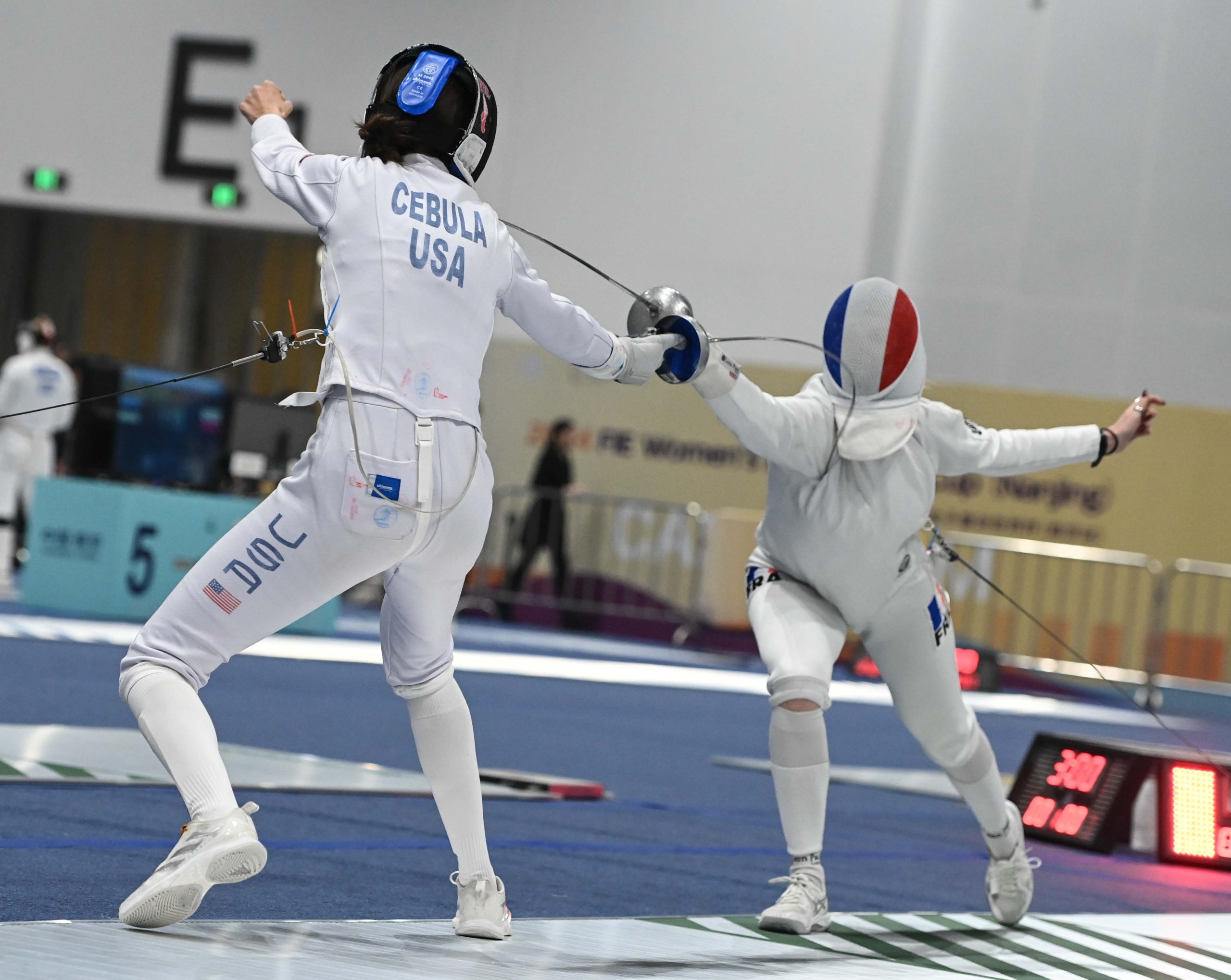
Q&A with Olympic Fencer Anne Cebula
As the Olympic Games approach and as NYAC athletes are selected to compete in Paris, we will be speaking with them to gain insight into their journey to the Games, into their preparations and into their aspirations once competition begins in the cauldron of Olympic competition. Here we speak with first-time Olympian, fencer Anne Cebula.
How did your pre-qualification training block compare to your current training preceding the Games?
There are three phases in the Olympic quad cycle: pre-qualification period, qualification period, and post-qualification period. The pre-qualification period is typically three years long, but because this quad was disrupted by the pandemic, it ended up only being about two years. This time is spent adjusting to the international circuit and working on compiling consistent results. You want to do well enough to stay on the travel team (top 12 in the US), but there is no pressure to make the national team yet (top four in the US). During the Olympic year, the national team is the Olympic team. This pre-qualification period is when you want to take the time to clean up on the “little things” so they don’t pop up when it counts – this includes finding out what works best for you in terms of adjusting to jet lag, learning how to cope with long competition days, generally getting exposure to foreign competitors, etc.
The qualification period for fencing lasts one year, ending three months before the Games, and this is when your results start counting towards the Olympic team. At this point, nothing is too new – the competition locations repeat every year, and there aren’t too many new faces on the international circuit during this critical year. Ideally by now you are a more stable fencer, but the hardest part of this period is fencing under pressure, and punching in high results so you can make the national team. The mental component of this is underratedly difficult. There are names that consistently make the national team in the years prior to the qualification period, but don’t make it during the Olympic year. This is due to a combination of mental game, and others purposely training to time their peaks for this period.
After one officially qualifies for the Olympics, there is the post-qualification period. You have about four months before the Games begin, but there are still three to four international competitions during this time. You understandably fence with less pressure, but you still want to do well, as your world ranking will decide your seeding at the Olympics. This is also the time to reinforce team chemistry for the team event – sometimes the team changes so rapidly during the Olympic year, the final roster may be a combination of people that hasn’t been used before. Also, your coach will coordinate with your trainer to make sure you have a training plan with specifically timed levels of volume, timed in such a way that you are in peak physical condition before the Games.
How are you mentally preparing for the Games?
The qualification period itself is so long, and so mentally taxing, that the mental prep for the Games doesn’t feel like anything new. If anything, there is less pressure, and you feel “freer” to fence. It’s about using this feeling to your advantage though, and not becoming too wildly comfortable and unfocused.
What have you enjoyed the most about the months preceding the Olympics, and what has been the most challenging?
I’ve enjoyed seeing results come out of my hard work, and that I successfully trusted that I’d peak when it mattered. Conversely, it has been challenging to experience the phenomenon of putting in the work and NOT making results – either due to personal mental block, or external circumstances like an unlucky seeding match-up, a bad referee call, etc. To stay sane during this process, you have to anticipate and accept that these things are unavoidable.
Is your Olympic journey how you imagined or different?
I was asked to draft my three year plan for Michael Aufrichtig (NYAC Fencing chair) at the start of the process back in 2021, and I still have the document saved on my computer. It is surreal to see that I followed my plan to a T – which was to not focus on making national team every year, but rather peaking at the right moment.
So yes, in a way the journey ended up being exactly how I imagined in terms of hitting benchmarks that I had set for myself. However, how I hit those benchmarks and lived through those times in between was a complete surprise to me. My coach warned me that there would be low moments, and that I would have to be mentally prepared to face either outcome at the end of the qualification period, but until you live through it, you don’t realize how heavy it actually is. It is very hard to mentally prepare for, unless you’ve been through the full cycle of an Olympic attempt before.
Do you have any plans, athletic or otherwise, after the Games?
I would still like to be involved in fencing in terms of accessibility and visibility – it is a major reason why I started the sport so late (I started freshman year of high school). Fencing has opened so many doors for me. Travel is one thing, but there are a handful of lifelong friends that I’ve made that I don’t know how else we would’ve been in the same room had it not been for fencing.
I am looking forward to developing other parts of my identity. It doesn’t help that I had such an accelerated and unusual path in the sport, so I really feel like the burnout has creeped into me faster than most. I feel like my other interests, even though I try my best to balance it all, have slowed as I’ve had to naturally set aside more and more time for the sport. This year specifically I put everything on pause – I trained full time. I told myself that I was either going to make the Olympics or not, but will retire regardless and give it my best effort. The motivation to end on a high note fueled me.
Maybe I will come back as a competitor when I am older. There is a Vet-80 division at USA Fencing North American Cups, and I cannot think of any other sport that has this many people at such an age still actively involved in the sport. The oldest competitor was 86 years old and picked up fencing at 72! His name is Victor Bianchini. “Fun” doesn’t even begin to describe fencing. It brings pure joy. I truly wish everyone could experience it.
Do you feel that top-class fencing and modeling complement each other?
Yes! Generally speaking, in both realms you have to be “on” and perform. I think that translates to many things in life.
More specifically, they ended up complementing each other very well when I was working during the pre-qualification period. I did not expect the negatives and positives of each to play into each other so readily.
So much of modeling is beyond your control – especially in the beginning of your career. If a job didn’t confirm, even though I knew I had a strong walk or received positive feedback, I learned to not take it personally. You don’t know what vision the casting director has in mind, and more often than not, the reason can be as arbitrary as a shoe size. There may be one look left in a runway lineup, and they need someone to fit a unique, one of one shoe. I learned to accept rejection, and move on. When I would be at practice later that day, I’d fence that much more intentionally because I would think to myself, “Well, this I have control over. If I practice this maneuver, I will score a touch.”
Conversely, if being in direct competition with my teammates all the time and actively fighting them felt emotionally draining, modeling was freeing. It was easy to befriend other women and genuinely root for their success. No one is really in direct competition with one another for a job because, again, so much of it is beyond your control. You see the same faces at castings, and when working abroad in an unfamiliar country, it is such a lovely experience to develop friendships on the job.
What are the challenges of simultaneously maintaining fencing and modeling careers?
The logistical end of balancing these things has luckily been manageable due to the support of my agency, Elite. They have always stressed that fencing comes first, and work around my competition calendar – which at certain points in the year can leave maybe a handful of days in the month to actively work.
Coincidentally, the largest fashion markets, namely Milan and Paris, are in countries where fencing is strong. I would be running from castings in fashion-oriented areas of Paris, to open bouting at the other end of the city in a large community sports gym – all in one day. I would show up with my equipment bag to castings because there wasn’t enough time to go home, and it ended up being a conversation piece in my favor a few times. However, in London the fencing scene is slightly weaker (there weren’t many active practices open during the week), so I remembered being a little antsy during my extended stay there, as we were only a month out from the start of the qualification period.
Where do your greatest ambitions and passions lie, in fencing or in professional modeling?
In fencing for sure. Unless you truly make it big – by what is truly a stroke of luck and fate – models have a lot less power than they used to in the industry. Back in the 90s and early 2000s, what I grew up with, models were seen as these irreplaceable public figures. They were media personalities at heart, invited to talk shows, the works. These days everyone is for the most part seen as nameless outside the industry, or as it’s unfortunately trending these days, hired in huge part to their online following. This happens even at some of the top luxury brands. It’s a little discouraging.
What you do in sport is in the records forever. There is more permanence in it. In the simplest terms: I love fashion, but it doesn’t always love me back, and I can’t control it. Maybe that will change in the future, but one thing that’s already been mutual for a while, and will continue to be, is the relationship I have with fencing. I may not be actively competing after Paris, but it will always be in my life in some capacity.